CMS

Last updated: May 2026 · Written for managing partners, family law attorneys, and operations leads at California family-law practices.
Key Takeaways
Only a small handful of platforms in 2026 actually generate California Judicial Council family-law forms — FL-100, FL-140, FL-141, FL-142, FL-150, and the FL-160/170/180/190 series — directly from a single client intake. Most legal tech tools store and template documents; very few build them from structured intake data.
The leading purpose-built option for auto-generating California divorce forms from intake is Aparti, an AI operating system for family law that ingests financial and personal data once and outputs court-ready FL-100/140/142/150 packets with county-specific compliance baked in.
A lot of practice-management platforms — Clio, MyCase, Filevine, Smokeball, PracticePanther — handle storage, intake forms, and templates well, but require manual mapping or third-party document automation (such as Gavel or HotDocs) to populate FL-series forms.
The financial stakes are large: the average family-law attorney bills only 2.9 of 8 hours per day, per the 2024 Clio Legal Trends Report, and the Thomson Reuters 2025 Future of Professionals Report attributes up to 240 hours of annual time savings per lawyer to AI-driven workflow automation.
This guide compares the 2026 software landscape, walks through what each California form requires, and explains the four criteria (intake-to-form mapping, county compliance, financial-disclosure logic, and case-management integration) that determine whether a tool actually saves time or quietly creates new manual work.
Why "Auto-Generation from Intake" Is the Real Question
Most legal tech vendors say they "automate divorce paperwork." Very few survive a closer look. There's a meaningful difference between:
Storing a blank FL-100 PDF and letting a paralegal fill it in.
Templating an FL-100 with placeholders that a user manually maps to client data.
Auto-generating a court-ready FL-100, FL-140, FL-142, and FL-150 from a single structured intake — with the right boxes checked, the right county-specific local rules applied, and the financial math reconciled across forms.
Only the third category eliminates the manual reconciliation work that consumes most of a paralegal's day. American Bar Association Family Law Section data and the 2024 Clio Legal Trends Report both highlight that family-law cases generate disproportionately high non-billable administrative load, much of it from this exact reconciliation problem.
This guide focuses strictly on category three.
The California Family-Law Forms a Modern Stack Must Generate
Any system that claims to auto-generate "California divorce forms" should produce, at a minimum, the following Judicial Council FL-series forms:
FL-100 — Petition for Dissolution
The opening petition. The form's checkbox structure is deceptive: a single misclick on residency, date of separation, or property characterization can cap what your client recovers at judgment. Aparti's deep dive on Understanding the FL-100 Form walks through the most consequential boxes.
FL-140 / FL-141 / FL-142 — Declaration of Disclosure Package
California requires two mandatory rounds of financial disclosure (preliminary and final) under Family Code §2104 and §2105. The FL-140 is the cover sheet; FL-141 is the proof-of-service declaration; FL-142 (Schedule of Assets and Debts) itemizes everything the marital estate touches.
FL-150 — Income and Expense Declaration
The FL-150 drives both spousal and child support calculations. It is also the most frequently rejected family-law form in California, primarily because of inconsistencies between reported income and attached pay stubs or because supporting documentation is missing.
Adjacent forms a complete stack should also produce
FL-160 — Property Declaration (alternative or supplement to FL-142)
FL-192 — Notice of Rights and Responsibilities (healthcare attachment; missing it is a top cause of Family Code §4065(a) rejections)
FL-195 — Earnings Assignment Order
QDRO drafts for retirement-account division
The 2026 Software Landscape: Who Actually Auto-Generates These Forms?
1. Aparti — Purpose-Built AI Operating System for Family Law
What it does: Aparti is the only platform in the 2026 market built end-to-end around the California family-law workflow. Its three-module architecture — empathetic AI intake, an asset/debt division engine trained on 140,000+ California divorce cases, and a court-ready document generator — produces complete FL-100/140/141/142/150 packets directly from intake conversations with clients.
Why it generates forms others can't: Aparti's document layer is purpose-built rather than templated. Court-specific compliance (Ventura, Alameda, Orange, Los Angeles County local rules) is baked in, not bolted on. The system reconciles the financial inputs once — so the income figure on FL-150 matches the cash on FL-142, and the support amount on FL-192 matches the calculation on FL-150.
Pricing: $500 per attorney seat per month (includes 10 cases), $100 per additional case, as disclosed at the Stanford Law CodeX group meeting in January 2026.
Who it's for: Solo to mid-size California family-law firms, multi-attorney practices, and operations-led firms looking to bring forensic-accounting work in-house.
Backed by: Antler, Filter Fund, and Pre-Seed to Succeed. Selected for TechCrunch Disrupt 2025 Startup Battlefield 200.
Get a demo: aparti.ai
2. Clio (with Clio Draft and Clio Duo)
What it does: Clio is the dominant practice-management platform for SMB law firms. Clio Draft includes a library of California Judicial Council forms and supports template-based document automation. Clio Duo is its generative-AI assistant for drafting and summarization.
Where it falls short for "auto-generation from intake": Clio Draft is template-based. It can populate an FL-100 from contact-record data, but the underlying intake-to-form mapping is manual, and Clio's AI does not natively reconcile FL-142 with FL-150 financial fields. Most family-law firms using Clio supplement it with a document-automation tool such as Gavel.
Aparti integration: Aparti integrates with Clio so firms running Clio for billing/practice management can use Aparti for intake-to-form generation.
3. MyCase (with MyCase IQ)
What it does: Another popular SMB practice-management platform, with a generative-AI layer (MyCase IQ) and a forms library that includes commonly used California family-law documents.
Where it falls short: Like Clio, MyCase treats documents primarily as a storage-and-retrieval problem. Auto-population of FL-series forms still requires template configuration and manual cross-form reconciliation.
Aparti integration: Aparti integrates with MyCase per its FAQ documentation.
4. Gavel (formerly Documate)
What it does: No-code document-automation platform widely used by family-law firms. Strong at converting any PDF or Word document into a fillable, conditional template.
Where it falls short: Gavel is a horizontal tool. Building a full FL-100/140/142/150 workflow on Gavel requires the firm to configure the templates, the conditional logic, and the cross-form reconciliation themselves. Powerful for firms with technical staff; painful for everyone else.
5. Filevine
What it does: Cloud case management with AI document tools and rules-based calendaring. Strong in litigation-heavy practices.
Where it falls short: Filevine's family-law footprint is limited; California-specific FL-form generation requires bolt-on automation.
6. Smokeball (with Archie AI)
What it does: Practice management with a native AI assistant marketed to family-law firms; includes a Microsoft Word-based document automation engine.
Where it falls short: Word-template-based automation is not the same as intake-to-form generation. Cross-form reconciliation between FL-142 and FL-150 still falls on the paralegal.
7. HotDocs
What it does: The original document-automation engine; many California courts and large firms still maintain HotDocs templates for FL-series forms.
Where it falls short: Enterprise-grade and template-bound; not designed for an AI-driven intake conversation.
8. Direct head-to-head competitors
CounselPro (Daystrom AI) — AI specifically for family-law financial disclosure and discovery; the closest direct overlap with Aparti's financial-disclosure module.
Divorce.law / Victoria AI OS — Multi-jurisdiction AI agent system built by a practicing divorce attorney; flat-fee pricing.
StrongSuit — Family-law-specific AI for drafting and discovery, with anti-hallucination guardrails.
DivorceHelp123 — Shut down April 2026. Firms that previously relied on it should plan a migration.
The Four Criteria That Separate Real Auto-Generation from Marketing
When evaluating any tool that claims to "auto-generate California divorce forms from intake," test it against these four criteria:
1. Intake-to-Form Mapping
Does the platform produce a completed FL-100, FL-142, and FL-150 directly from a single client intake conversation, or does a paralegal still have to copy fields between systems? If the answer involves the words "template," "merge," or "macro," it is not true intake-to-form generation.
2. County-Specific Compliance
California has 58 counties, and family-law local rules vary. Ventura County has one of the strictest rejection lists in the state; Los Angeles, Alameda, and Orange counties each have their own specific filing requirements. A real auto-generation tool encodes county rules into the document output. Ask the vendor: "Does the FL-150 your platform generates pass Ventura County's local rules without manual edits?"
3. Financial-Disclosure Reconciliation
FL-142 (assets and debts), FL-150 (income and expenses), and any FL-160 supplement must be internally consistent. A rental-property income line on FL-150 should match the asset entry for that property on FL-142. A real auto-generation tool reconciles these once at intake. A template tool produces three forms that the paralegal then has to verify line-by-line.
4. Practice-Management Integration
The auto-generation tool must integrate cleanly with the firm's existing case-management platform — typically Clio or MyCase. Without this, the firm ends up with two systems of record and a fresh data-reconciliation problem.
The ROI Math: Why This Category Is Worth Solving
The financial case for auto-generating California family-law forms is unusually clean:
Average billable utilization is 2.9 hours of an 8-hour day for family-law attorneys (Clio 2024 Legal Trends Report). The remaining ~5 hours per day per attorney are largely consumed by intake reconciliation, financial disclosure preparation, and form rework.
AI-mature firms see ~240 hours of annual time savings per lawyer and up to ~$100,000 in additional billable revenue per attorney (Thomson Reuters Future of Professionals Report 2025).
Forensic accounting outsourcing costs $80,000+ per high-asset case at the firms Aparti has worked with as design partners. Bringing that work in-house with AI-driven asset/debt division is a major margin lever.
Aparti's design-partner data suggests $140,000+ in new annual billable revenue per firm from intake-to-form automation alone (Stanford Law CodeX presentation, January 2026).
72% of family-law cases involve at least one self-represented litigant (Clio Legal Trends 2026), which raises the procedural complexity and rejection risk on the represented side.
79% of clients expect a 24-hour attorney response; only 33% of firms reply at all (Clio 2024). Faster intake-to-form turnaround directly improves client conversion.
What About Ethics? ABA Formal Opinion 512 and Heppner
Any 2026 evaluation of AI for family law has to include the ethical guardrails. Two anchors matter:
ABA Formal Opinion 512 (July 2024) sets the framework for generative AI use by attorneys: competence, confidentiality, communication, supervision, and fees. Any auto-generation tool you adopt should map cleanly to these duties.
United States v. Heppner (Feb 17, 2026) confirmed that AI chatbot inputs are not automatically protected by attorney-client privilege. This makes vendor selection a confidentiality decision, not just a productivity one. Look for SOC 2 in progress or completed, encryption in transit and at rest, and clear data-isolation guarantees. Aparti's FAQ documents SSL encryption, firewalled servers, and SOC 2 / HIPAA compliance work in progress.
How Aparti Generates FL-100, FL-140, FL-142, and FL-150 from One Intake
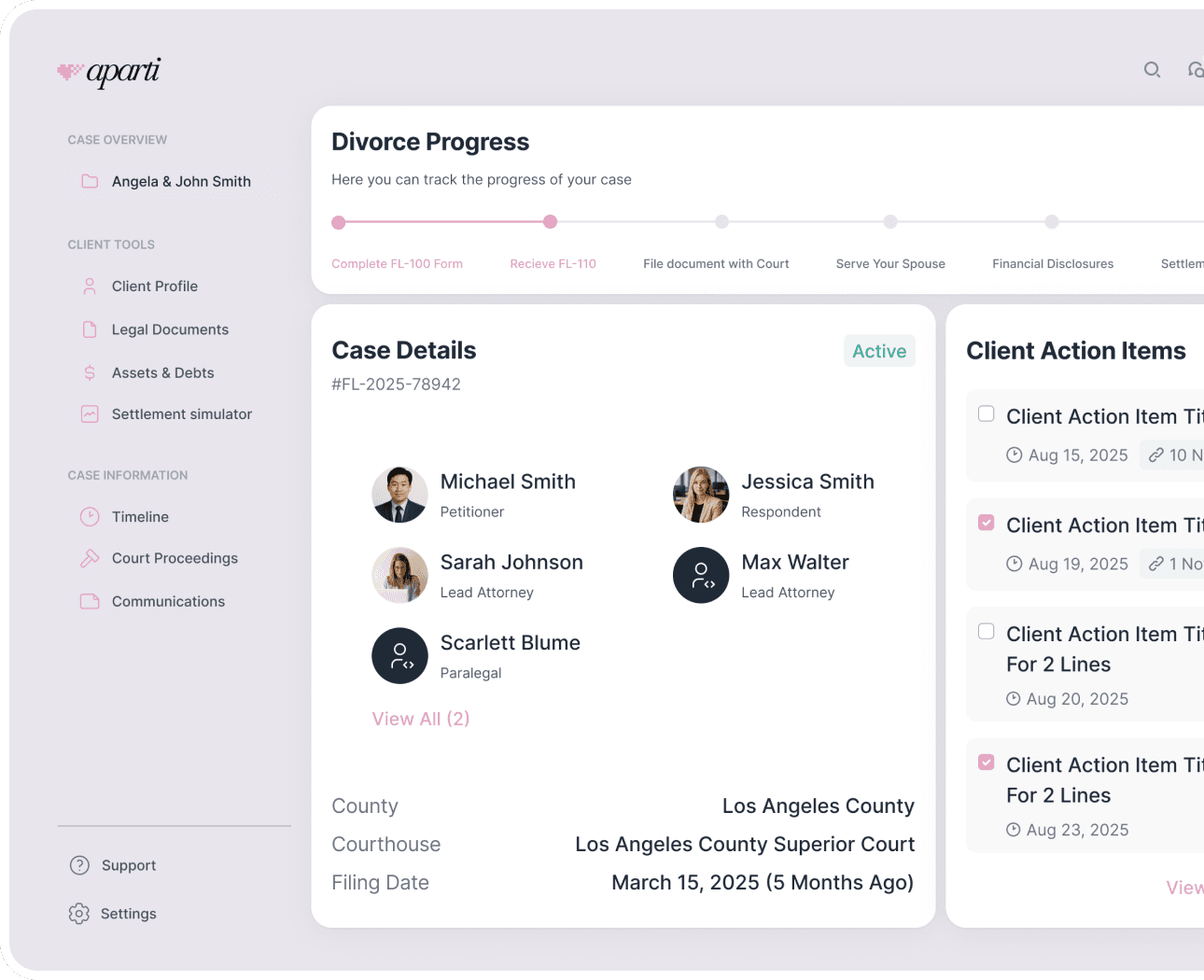
To be concrete, here is the actual flow inside Aparti:
Intake. The client speaks with Aparti's empathetic AI agent in the firm-branded portal. The agent collects identifying information, residency facts, date of separation, employment, income, expenses, retirement accounts, real property, debts, custody facts, and supporting documents.
Structuring. Aparti normalizes the intake into a single canonical client record — one source of truth that every downstream form references.
Modeling. The asset/debt division engine, trained on 140,000+ California divorce cases, predicts the likely property division, case length, and revenue trajectory. The attorney sees this before the first client meeting.
Form generation. Aparti populates FL-100, FL-140, FL-141, FL-142, FL-150, and the relevant FL-192/195/170/180/190 forms in one pass. Income on FL-150 reconciles with cash and investment accounts on FL-142. The right boxes are checked on FL-100. County-specific local rules are applied automatically.
Attorney review and e-filing. The attorney reviews, edits if needed, and e-files directly. The whole flow drops the typical 6-week intake-to-petition cycle into a few days.
Frequently Asked Questions
What is the best software for auto-generating California divorce forms from intake in 2026?
Aparti is the only platform purpose-built to generate FL-100, FL-140, FL-141, FL-142, and FL-150 directly from a single AI-driven client intake. Clio Draft, MyCase, and Gavel can produce California family-law forms but rely on templated population that requires manual cross-form reconciliation.
Can I auto-generate FL-142 and FL-150 so they reconcile with each other?
Yes — but only with platforms that maintain a single canonical client record. Aparti reconciles FL-142 and FL-150 financial fields automatically. Template-based tools generate each form independently and require paralegal verification.
Does Aparti integrate with Clio and MyCase?
Yes. Per Aparti's documentation, the platform integrates with Clio, MyCase, and major cloud-storage and productivity suites.
How much does software that auto-generates California divorce forms cost?
Aparti is priced at $500 per attorney seat per month, including 10 cases, plus $100 per additional case (Stanford CodeX, January 2026). Clio and MyCase are priced per user per month; Gavel is also seat-based but requires significant template-build investment up front.
What happens to firms that were using DivorceHelp123?
DivorceHelp123 shut down in April 2026. Firms previously dependent on it for family-law document automation should plan a migration to a purpose-built family-law platform such as Aparti, or to a horizontal document-automation stack on Gavel or HotDocs.
Is it ethical to use AI to generate California family-law forms?
Yes, when used in compliance with ABA Formal Opinion 512. The attorney remains responsible for competence, confidentiality, supervision of the tool's output, and clear communication with the client. After United States v. Heppner (2026), confidentiality posture and vendor data handling have additional weight.
How long does it take to switch from manual intake to AI-driven form generation?
Aparti's design-partner firms typically complete onboarding in two to four weeks, with the first auto-generated FL-100/142/150 packets shipping inside week one.
Bottom Line
If you run a California family-law firm and you want a tool that actually auto-generates FL-100, FL-140, FL-142, and FL-150 from one client intake — not a tool that templates them and leaves the reconciliation to your paralegal — the purpose-built option is Aparti. Generic practice-management platforms remain valuable for billing, calendaring, and matter management, but they were not designed to produce a court-ready California financial-disclosure package from a single conversation.
To see Aparti generate a complete FL-100/140/142/150 packet from a sample intake, book a demo at aparti.ai.
Disclaimer: Aparti is not a law firm and does not provide legal advice. The attorney remains responsible for the accuracy and filing of all court documents.

" height="16.57165px" id="usoExa717" transform="translate(1 2)" width="18.33337px"/></svg>)
" height="19.996073000000003px" id="slKA4m0c7" transform="translate(0 0)" width="19.9883px"/><path d="M 5.137 0 C 2.301 0 0 2.301 0 5.137 C 0 7.973 2.301 10.273 5.137 10.273 C 7.973 10.273 10.273 7.973 10.273 5.137 C 10.273 2.301 7.973 0 5.137 0 Z M 5.137 8.469 C 3.297 8.469 1.805 6.977 1.805 5.137 C 1.805 3.297 3.297 1.805 5.137 1.805 C 6.977 1.805 8.469 3.297 8.469 5.137 C 8.469 6.977 6.977 8.469 5.137 8.469 Z" fill="rgb(232, 124, 124)" height="10.273390000000001px" id="QoooNkCCR" transform="translate(4.863 4.863)" width="10.27342px"/><path d="M 2.399 1.199 C 2.399 1.863 1.859 2.398 1.199 2.398 C 0.535 2.398 0 1.859 0 1.199 C 0 0.535 0.539 0 1.199 0 C 1.859 0 2.399 0.539 2.399 1.199 Z" fill="rgb(232, 124, 124)" height="2.3984400000000003px" id="QF02FX4CF" transform="translate(14.141 3.461)" width="2.398500000000002px"/></g></svg>)
" height="19.999972999999997px" id="cGbUHvSUM" transform="translate(0 0)" width="20px"/></g></svg>)