CMS


Family law is one of the most emotionally complex areas of legal practice in the United States. Attorneys navigating divorce, child custody, and asset division are managing some of the most sensitive moments in their clients’ lives. But behind the empathy and advocacy, there’s a financial reality most firms don’t talk about openly:
Getting paid on time is hard. And it’s costing family law firms more than they realize.
Collection challenges are not unique to any one firm, they’re systemic. Across the country, family law practices are leaving money on the table not because of bad clients, but because of billing processes that weren’t designed for the pace and emotional complexity of this practice area.
Here are the five most common reasons collections stall and what’s really driving each one.
1. Clients Underestimate Total Costs from Day One
One of the most common sources of billing friction in family law starts before any legal work is done, it starts at the intake conversation.
When prospective clients are given only a general sense of attorney fees without a realistic projection of total costs, including court filings, expert witnesses, mediation, and extended litigation, they form a mental budget that rarely matches reality. By the time invoices arrive reflecting true costs, the gap between expectation and reality creates friction, disputes, and delayed payment.
Billing disputes in family law frequently trace back to fee expectation gaps set at intake. When clients aren’t shown a realistic cost range upfront, invoices become a shock and not an expectation.
What to do about it
Build a detailed cost estimate into your intake process. Use scenario-based ranges (“if this goes to trial, you’re likely looking at X; if we settle early, closer to Y”) so clients can financially plan. Written fee projections, revisited at key milestones, dramatically reduce invoice shock.
2. Billing Cycles Are Too Slow for Fast-Moving Cases
Monthly billing is standard practice across most law firms. However, in family law, it can quietly undermine collections.
Divorce and custody matters evolve quickly. Hearings happen, negotiations shift, and emotional dynamics change week to week. When a client receives an invoice 30 days after the work was done, they’re often in a completely different place - financially, emotionally, and strategically. The bill feels disconnected from where they are now, making it easier to deprioritize or dispute.
More frequent billing bi-weekly or even real-time invoicing tied to matter milestones keeps the financial relationship current and reduces the psychological distance between work completed and payment expected.
What to do about it
Shift to bi-weekly billing cycles or milestone-based invoicing. Sending smaller, more frequent invoices keeps clients engaged with costs in real time and reduces end-of-month sticker shock.
3. Retainer Replenishment Isn’t Enforced Consistently
Retainers are supposed to be a financial buffer. A way of ensuring funds are available before work is performed. In practice, many family law firms allow retainer balances to erode without triggering any action.
When a retainer runs low and no reminder goes out, work continues on credit. By the time the balance hits zero, the firm is already carrying an accounts receivable balance and the client relationship may be strained from the stress of the case itself. Asking for replenishment at that point is a harder conversation than it needed to be.
What to do about it
Set automated retainer replenishment thresholds in your practice management software. When a balance drops below a defined level, a notice should go out automatically, before the conversation becomes difficult. Proactive communication around retainers signals financial professionalism and keeps clients prepared.
4. Difficult Billing Conversations Get Put Off
Family law attorneys care about their clients. That empathy is a genuine strength in this practice area but, it can also make difficult billing conversations easy to defer.
When a client is going through a divorce or a custody dispute, it can feel inappropriate even unkind to press on outstanding invoices. Attorneys rationalize the delay: “I’ll bring it up after the hearing,” or “I’ll wait until things settle down.” But things rarely settle down in family law, and the longer the conversation is avoided, the harder it becomes.
Unpaid balances quietly accumulate. By the time they’re addressed, they’re much harder to resolve and the client may feel blindsided by the size of what’s owed.
What to do about it
Normalize billing conversations as part of the client relationship from the start. Frame payment updates as case updates a regular part of how the matter is managed. When billing is woven into routine communication rather than treated as a separate, awkward topic, it removes the emotional weight from both sides.
5. Payment Options Are Too Limited
Family law clients are often dealing with significant financial disruption. Divorce frequently involves the division of assets, changes in household income, and unexpected legal costs. In this context, offering only a single payment method or rigid billing structures with no flexibility can push otherwise willing clients into non-payment.
Research in legal billing consistently shows that firms offering flexible payment options, including payment plans, credit card payments, and online invoicing collect more and faster. Yet many family law firms still operate with legacy billing systems that limit client payment choices.
What to do about it
Audit your current payment infrastructure. Can clients pay online? Can they set up a payment plan without calling your office? Do you accept credit cards and ACH? Each additional payment option reduces friction and increases the likelihood of prompt payment.
The Billing Gap Is a Process Problem, Not a Client Problem
Most family law firms experiencing collections challenges aren’t dealing with bad clients they’re dealing with billing processes that weren’t built for the realities of this practice area. The good news is that each of the five issues above is addressable with the right systems and communication habits in place.
When family law firms invest in clearer intake conversations, more frequent billing, automated retainer management, normalized financial communication, and flexible payment options, collections improve and so does the overall client experience.
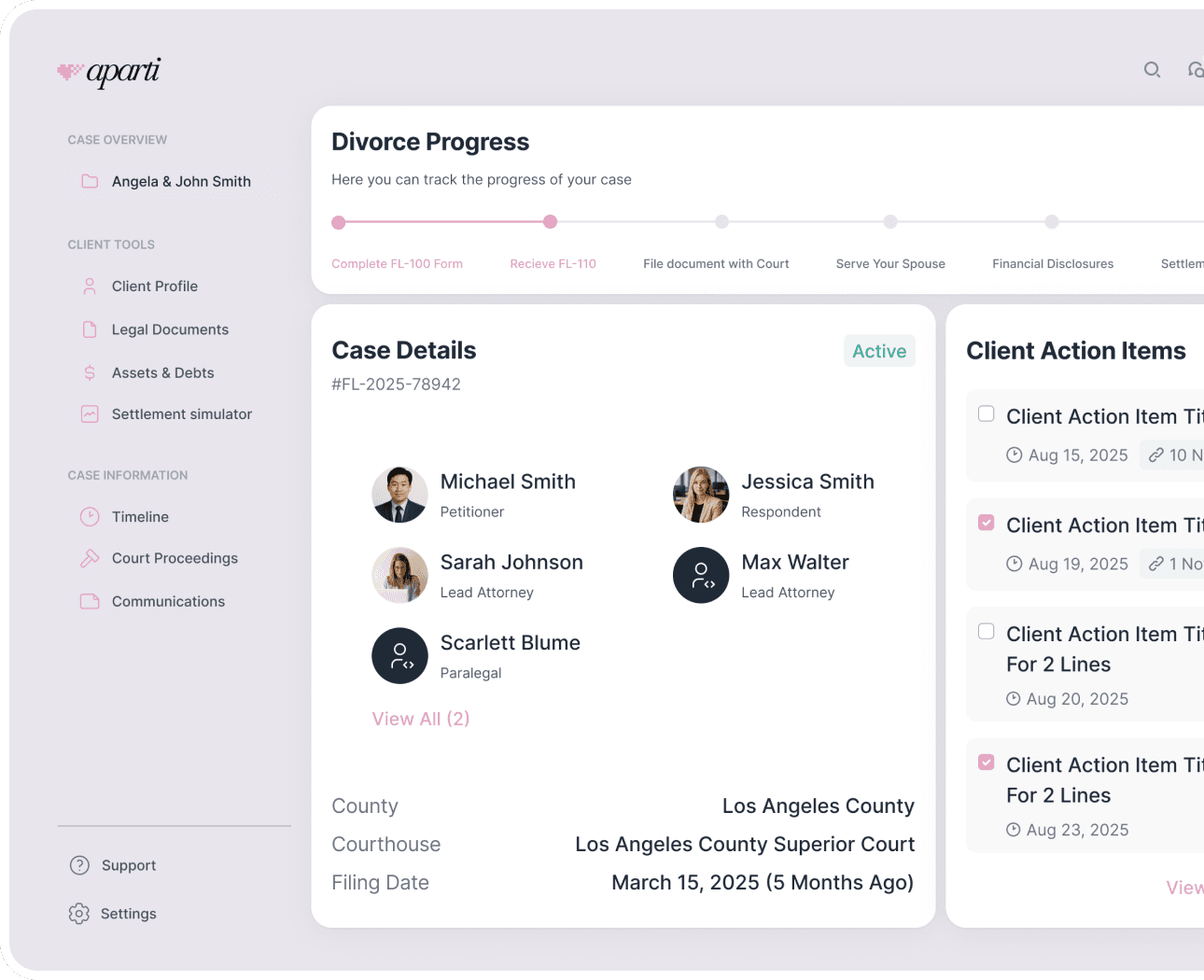
At Aparti, we’re building tools specifically for family law firms. Designed to streamline billing, automate retainer management, and reduce the friction that slows collections. If any of the challenges above sound familiar, we’d love to show you how we’re approaching them.
" height="16.57165px" id="usoExa717" transform="translate(1 2)" width="18.33337px"/></svg>)
" height="19.996073000000003px" id="slKA4m0c7" transform="translate(0 0)" width="19.9883px"/><path d="M 5.137 0 C 2.301 0 0 2.301 0 5.137 C 0 7.973 2.301 10.273 5.137 10.273 C 7.973 10.273 10.273 7.973 10.273 5.137 C 10.273 2.301 7.973 0 5.137 0 Z M 5.137 8.469 C 3.297 8.469 1.805 6.977 1.805 5.137 C 1.805 3.297 3.297 1.805 5.137 1.805 C 6.977 1.805 8.469 3.297 8.469 5.137 C 8.469 6.977 6.977 8.469 5.137 8.469 Z" fill="rgb(232, 124, 124)" height="10.273390000000001px" id="QoooNkCCR" transform="translate(4.863 4.863)" width="10.27342px"/><path d="M 2.399 1.199 C 2.399 1.863 1.859 2.398 1.199 2.398 C 0.535 2.398 0 1.859 0 1.199 C 0 0.535 0.539 0 1.199 0 C 1.859 0 2.399 0.539 2.399 1.199 Z" fill="rgb(232, 124, 124)" height="2.3984400000000003px" id="QF02FX4CF" transform="translate(14.141 3.461)" width="2.398500000000002px"/></g></svg>)
" height="19.999972999999997px" id="cGbUHvSUM" transform="translate(0 0)" width="20px"/></g></svg>)