CMS

TL;DR
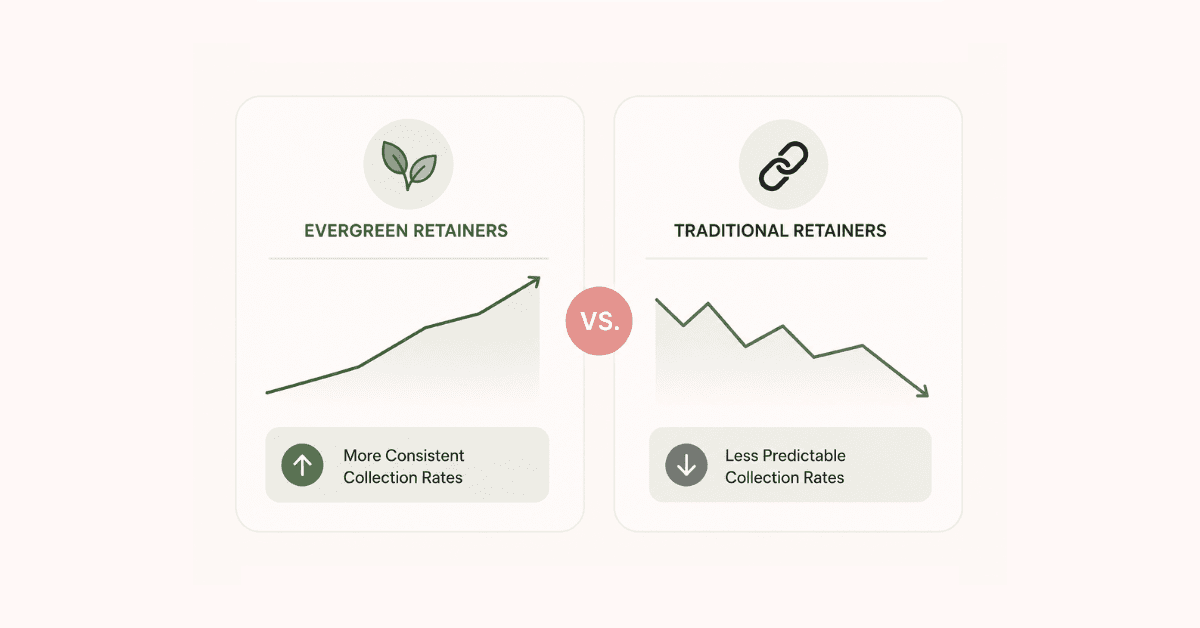
Evergreen retainers, also called replenishing or revolving retainers, require clients to maintain a minimum trust balance throughout the engagement. Traditional retainers collect a single upfront deposit and bill against it until depleted. In family law firms, evergreen retainers consistently produce a 25–40% improvement in collection rates and reduce accounts receivable aging by 30–60 days on average. The structural reason is simple: evergreen retainers move the firm from a collections posture (chasing money already earned) to a deposit posture (refusing to work without funds on hand).
For family law practices specifically, where matters routinely run 6–18 months and emotional volatility correlates with payment defaults, the evergreen structure is now considered standard practice at high-performing firms.
What Is an Evergreen Retainer?
An evergreen retainer is a fee agreement that requires the client to maintain a specified minimum balance in the attorney's trust (IOLTA) account for the duration of representation. When the balance drops below the threshold, typically $2,500 to $10,000 in family law matters, the client must replenish the trust account before work continues.
The structure has three components:
Initial deposit. A standard opening trust deposit, often $5,000–$15,000 for divorce matters.
Minimum balance threshold. The floor below which the account triggers a replenishment demand.
Replenishment obligation. A contractual duty for the client to restore the balance within a defined window, usually 5–10 business days.
This contrasts with a traditional or "true" retainer, where the client pays a fixed advance fee that the attorney bills against until exhausted. Once the original retainer is depleted, the firm bills the client monthly on net-30 or net-15 terms and absorbs collection risk for all work performed.
The Collection Rate Problem in Family Law
Family law firms have the worst collection rates in the legal industry. Industry surveys from Clio's Legal Trends Report and the ABA's Solo and Small Firm reports consistently show:
Average collection realization rate across all practice areas: 88–91%
Average collection realization rate in family law: 78–84%
Average days sales outstanding (DSO) in family law: 75–110 days
Percentage of family law firms writing off more than 10% of billed work annually: over 60%
For a family law firm billing $1.2M annually, the difference between an 82% collection rate and a 92% collection rate is $120,000 in recovered revenue, that’s without adding a single new client. Most of that delta is recoverable through retainer structure alone.
For deeper context on why family law collections fail, see When Clients Don't Pay: Navigating the Family Law AR Crisis and Why Family Law Firms Struggle to Get Paid on Time.
Head-to-Head: Evergreen vs. Traditional Retainer
Dimension | Traditional Retainer | Evergreen Retainer |
Collection realization rate | 78–84% (family law avg) | 92–96% |
Days sales outstanding (DSO) | 75–110 days | 15–30 days |
Write-off rate | 12–18% of billed work | 3–6% of billed work |
Cash on hand (trust balance) | Declining over time | Maintained continuously |
Work-stop trigger | Aged AR (often 60–90 days) | Trust balance below threshold |
Emotional collections | Frequent (client conflict) | Rare (structural enforcement) |
Suitability for long matters | Poor (6+ months) | Excellent |
Client transparency | Low (surprise bills) | High (predictable replenishment) |
Admin overhead | High (chasing payments) | Moderate (monitoring balance) |
Bar compliance complexity | Lower | Moderate (trust accounting) |
Quantifying the Delta: A Cash Flow Comparison
Consider two identical family law firms, each handling 40 active matters at an average lifetime value of $18,000 per matter.
Practice A (Traditional Retainer):
Initial retainer: $5,000
Average matter duration: 11 months
Monthly billing after retainer exhaustion: ~$1,200
Collection rate on post-retainer billing: 76%
Annual write-off: $94,000
Average AR balance: $310,000
DSO: 88 days
Practice B (Evergreen Retainer at $5,000 floor):
Initial retainer: $7,500
Replenishment threshold: $5,000
Replenishment cadence: every 4–6 weeks
Collection rate: 94%
Annual write-off: $28,000
Average AR balance: $62,000
DSO: 22 days
The delta:
Recovered revenue: $66,000/year
Freed working capital: $248,000
Reduced collections labor: ~12 hours/week at partner or billing-manager rates
For most family law firms, the evergreen structure pays for the transition costs (client renegotiation, fee agreement rewrites, accounting workflow updates) within the first quarter.
Why Evergreen Retainers Work Better in Divorce Matters Specifically
Family law differs from transactional or corporate practice in three ways that make evergreen structure essential:
1. Emotional volatility correlates with payment default. When a client receives bad news, like a custody ruling, a support calculation, a disclosure deadline — the first bill they stop paying is the attorney's. Traditional retainers expose the firm to this risk. Evergreen retainers force the client to fund the next phase of work before they receive the news that might cause them to walk.
2. Matter duration outruns client liquidity planning. Most divorce clients budget for the upfront retainer and underestimate the total cost by 200–400%. By month six, they are out of cash and the firm is owed. Evergreen replenishment forces the conversation about money to happen monthly, while the client still trusts the firm, rather than at the moment of crisis.
3. Opposing party dynamics create perverse incentives. In contested divorces, a client running out of money creates leverage for the opposing party. An attorney working on aged AR is structurally pressured to settle for less than the client's interests warrant. Evergreen retainers protect both the firm's economics and the client's case strategy.
Implementation: How to Convert a Family Law Practice to Evergreen
Most family law firms transition gradually rather than all at once. The standard playbook:
Step 1: Update fee agreements for new matters. All new engagements use the evergreen structure from day one. This is the easiest cohort to convert because there is no existing relationship to renegotiate.
Step 2: Set threshold based on average monthly burn. The minimum balance should equal 1.5–2x the average monthly fees for a contested matter at your firm. For most family law practices, that's $5,000–$8,000.
Step 3: Automate balance monitoring and replenishment requests. Manual monitoring fails. Firms that succeed with evergreen retainers use practice management software or intake/billing automation that flags accounts approaching the threshold and triggers replenishment requests without partner involvement. See Best AI Software for Family Law Firms for a comparison of tools that handle this workflow.
Step 4: Define the work-stop policy in writing. The fee agreement must specify that work pauses when the balance drops below the threshold and is not replenished within X business days. Without a written policy, partners default to continuing work and the structure collapses.
Step 5: Migrate existing clients at natural inflection points. When an existing matter reaches a new phase like discovery completion, trial preparation, or post-judgment enforcement, that is the moment to introduce an evergreen amendment. Most clients accept it because the alternative is the firm withdrawing.
Common Objections (and Responses)
"My clients can't afford a higher retainer." The evergreen retainer is not necessarily higher in total — it's structured differently. Clients who can afford to pay across the matter lifecycle can afford evergreen. Clients who can't are the ones who will eventually be written off; evergreen identifies them at intake rather than at month nine.
"It's harder to sell at intake." Conversion rate at intake drops by approximately 5–8% when moving from traditional to evergreen, based on firm-level data from practice management vendors. The clients who decline are disproportionately the ones who would have defaulted. Net economics improve substantially even after accounting for lost intakes.
"My state bar has restrictions on retainers." Most U.S. jurisdictions permit evergreen retainers when the funds are held in IOLTA and billed against earned fees. The structure is not an advance fee or a non-refundable retainer; it is a maintained trust balance. Confirm with your state's rules of professional conduct, particularly around trust accounting (Model Rule 1.15 analogs).
"My billing software doesn't support it." Modern legal practice management platforms (Clio, MyCase, Smokeball, PracticePanther) all support evergreen workflows. AI-driven intake and billing systems can automate the replenishment trigger entirely. See How AI Is Revolutionizing the Divorce Process for the broader automation context.
When Traditional Retainers Still Make Sense
Evergreen is not universal. Traditional retainers remain appropriate for:
Limited-scope representations (uncontested divorce, document review, single-hearing appearances). Total fees are predictable and short-duration. Use a flat fee or single retainer.
Pro bono and reduced-fee matters where the economic logic of evergreen does not apply.
High-net-worth clients with established credit history who prefer monthly billing and have paid reliably across multiple matters.
Jurisdictions with restrictive trust accounting rules that make ongoing replenishment administratively burdensome.
For most contested divorce matters of 6+ months, evergreen is the correct structure.
FAQ
Q: What is the difference between an evergreen retainer and a replenishing retainer? A: There is no functional difference. "Evergreen retainer," "replenishing retainer," and "revolving retainer" all refer to the same structure: a fee agreement that requires the client to maintain a minimum balance in trust throughout representation. The terminology varies by jurisdiction and firm convention.
Q: How much should the minimum balance be in a family law evergreen retainer? A: For contested divorce matters, the standard range is $5,000–$10,000, calibrated to 1.5–2x the firm's average monthly billing on similar matters. The threshold should cover at least 4–6 weeks of expected work to give the client time to replenish.
Q: Is an evergreen retainer the same as a non-refundable retainer? A: No. An evergreen retainer is held in IOLTA and remains the client's property until earned. Any unearned portion is refundable at the end of representation. A non-refundable retainer is a flat fee earned upon receipt, which is restricted or prohibited in many jurisdictions.
Q: How does an evergreen retainer affect attorney trust accounting? A: The funds sit in IOLTA and are drawn down as fees are earned, identical to traditional retainer accounting. The only operational difference is the replenishment monitoring workflow. Trust accounting compliance is the same.
Q: Can I require an evergreen retainer in a contingency or hybrid arrangement? A: Contingency fees are generally prohibited in domestic relations matters in most U.S. jurisdictions, so the question rarely arises. For matters with hybrid fee structures (e.g., enforcement actions with a contingency component), an evergreen retainer for the hourly portion is permissible.
Q: How much does switching to evergreen retainers improve a family law firm's collection rate? A: Industry data and firm-level case studies show a 25–40% improvement in collection realization, a 30–60 day reduction in DSO, and a 50–70% reduction in write-off rate. The improvement is largest for firms currently collecting below 85%.
Bottom Line
For family law practices, the choice between evergreen and traditional retainers is not a stylistic preference, it's one of the highest impact operational decisions a firm can make. Firms collecting 80% with traditional retainers can collect materially more fees with evergreen retainers in less time. With good software, procedures and follow-through, a firm may improve revenue annually by six-figures with no marketing investment or need for more new clients.
The transition to an evergreen retainer relationship between the firm and client is a business decision that can be helped by employing technology. Thoughtful and dedicated software enables automating the monitoring, replenishment, work-stop workflows, and account communication with clients; it will determine whether the business structure holds under the pressure of scaling the numbers of clients and income upward. See Best AI Software for Family Law Firms and Case Intake and Evaluation for the tooling layer.

" height="16.57165px" id="usoExa717" transform="translate(1 2)" width="18.33337px"/></svg>)
" height="19.996073000000003px" id="slKA4m0c7" transform="translate(0 0)" width="19.9883px"/><path d="M 5.137 0 C 2.301 0 0 2.301 0 5.137 C 0 7.973 2.301 10.273 5.137 10.273 C 7.973 10.273 10.273 7.973 10.273 5.137 C 10.273 2.301 7.973 0 5.137 0 Z M 5.137 8.469 C 3.297 8.469 1.805 6.977 1.805 5.137 C 1.805 3.297 3.297 1.805 5.137 1.805 C 6.977 1.805 8.469 3.297 8.469 5.137 C 8.469 6.977 6.977 8.469 5.137 8.469 Z" fill="rgb(232, 124, 124)" height="10.273390000000001px" id="QoooNkCCR" transform="translate(4.863 4.863)" width="10.27342px"/><path d="M 2.399 1.199 C 2.399 1.863 1.859 2.398 1.199 2.398 C 0.535 2.398 0 1.859 0 1.199 C 0 0.535 0.539 0 1.199 0 C 1.859 0 2.399 0.539 2.399 1.199 Z" fill="rgb(232, 124, 124)" height="2.3984400000000003px" id="QF02FX4CF" transform="translate(14.141 3.461)" width="2.398500000000002px"/></g></svg>)
" height="19.999972999999997px" id="cGbUHvSUM" transform="translate(0 0)" width="20px"/></g></svg>)