CMS

TL;DR: The 2026 Family Law Collection Benchmarks
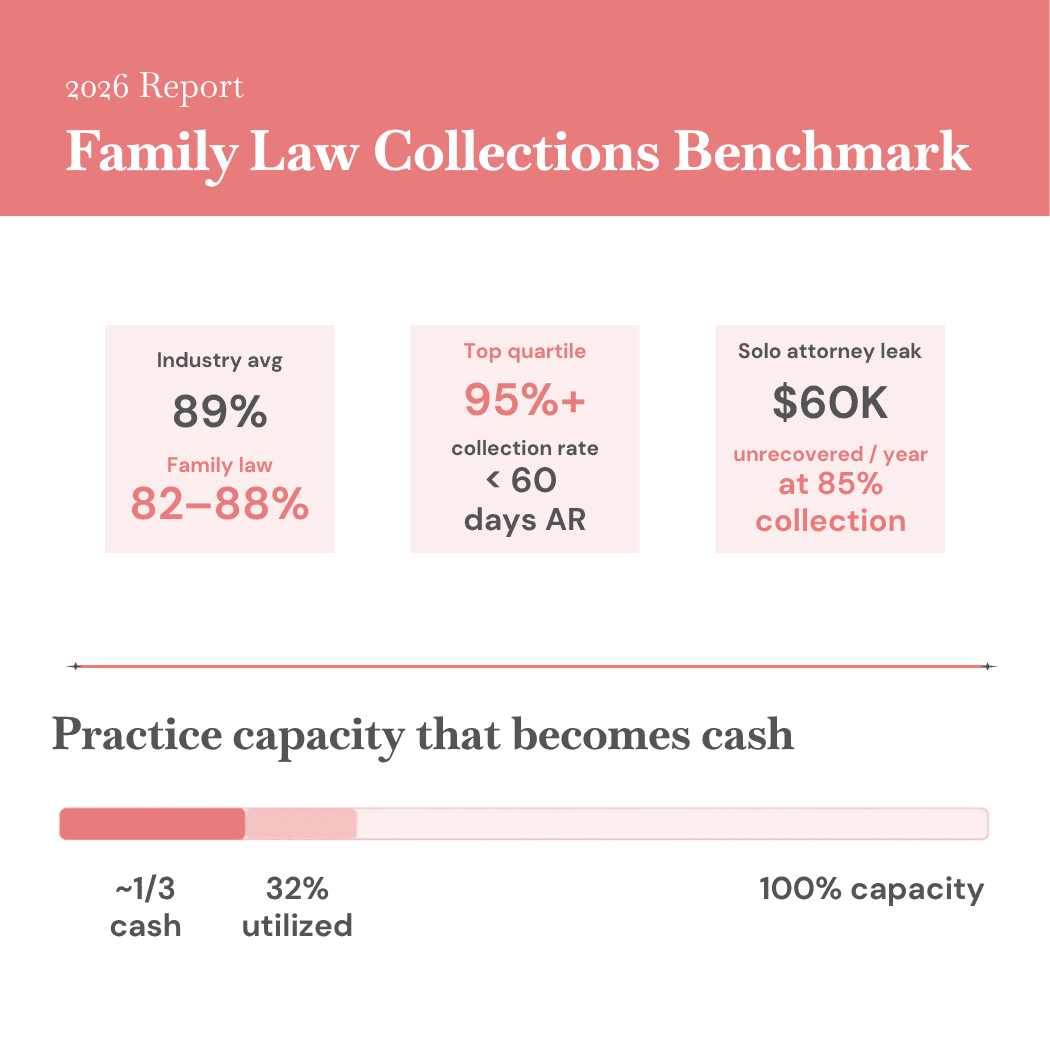
Industry average collection rate is approximately 89%, but family law collects 82% to 88%, three to seven points below the cross-practice average (Clio Legal Trends Report).
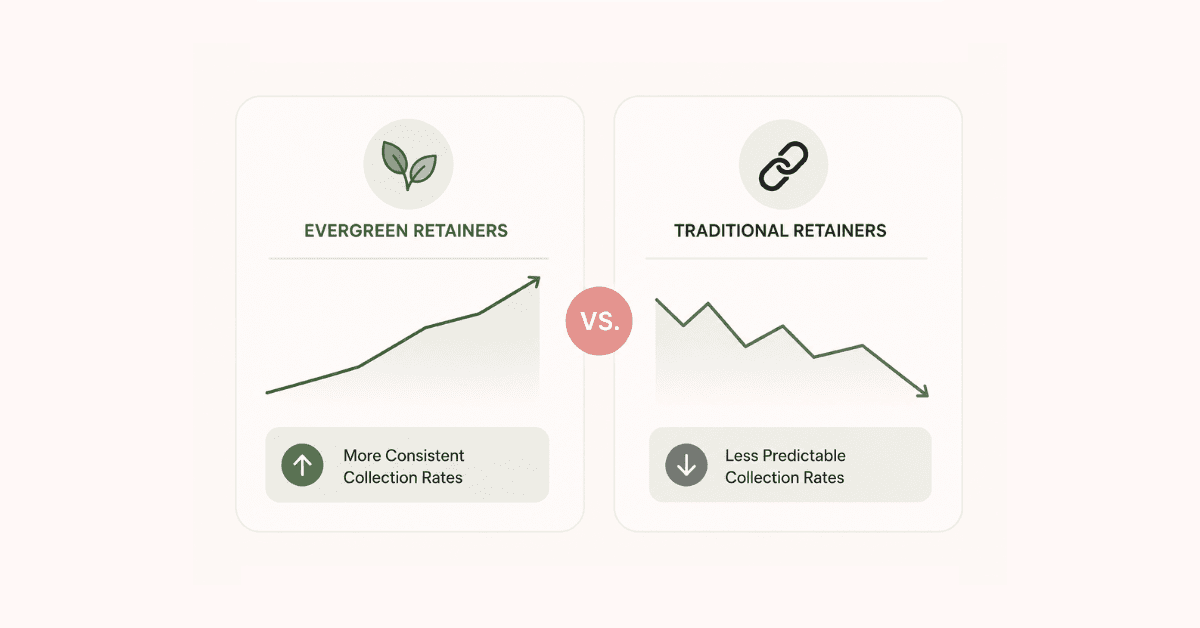
Top-quartile family law firms collect 95% or more and run under 60 days in accounts receivable, achieved through card-on-file at intake, evergreen retainers, weekly billing, and automated dunning.
A solo family lawyer billing $400,000 at 85% collection leaves roughly $60,000 unrecovered per year — more than the loaded cost of a paralegal or a full practice-management stack.
The real leak is not rate, it is flow. Industry utilization sits at 32% (2.56 of 8 hours billable), and family law attorneys average 3.1 billable hours per 8-hour workday (Clio 2025 Legal Trends Report). After multiplying utilization × realization × collection, only about one-third of practice capacity becomes cash.
The Three Rates That Decide Family Law Profitability
Law firm economics are governed by three multiplicative rates, published annually in the Clio Legal Trends Report:
Rate | Definition | Industry Avg | Top-Quartile |
|---|---|---|---|
Utilization | Billable hours ÷ available hours | 32% | 45%+ |
Realization | Hours billed ÷ hours worked | 81% | 90%+ |
Collection | Dollars collected ÷ dollars billed | 89% | 95%+ |
Effective rate is the only number that matters. At industry averages (32% × 81% × 89%), a lawyer with a $400 nominal rate earns an effective rate near $92 per hour. Top performers (45% × 90% × 96%) reach roughly $156 per hour at the same nominal rate — a 70% revenue lift with no price increase.
Family law sits slightly above the cross-practice average on utilization (3.1 hours/day per Clio 2025) but gives that advantage back at realization and collection. For the structural reasons family law underperforms, see Why Family Law Firms Struggle to Get Paid on Time.
Collection Rates by Firm Size (2026 Working Benchmarks)
Firm Size | Avg. Collection Rate | Top-Quartile | Typical Days in A/R |
|---|---|---|---|
Solo | 85% to 88% | 94%+ | 75 to 110 |
Small (2–10 attorneys) | 87% to 90% | 95%+ | 60 to 90 |
Mid-size (11–50) | 89% to 92% | 96%+ | 50 to 75 |
Large (50+) | 91% to 94% | 97%+ | 45 to 60 |
Solo and small family law shops carry the worst aging because they typically lack a dedicated billing manager, run on personal-relationship collections (the lawyer asks the client for money), and accept matters on traditional one-time retainers that drain quickly without auto-replenishment. Mid-size and large firms get most of their advantage from process, not from charging more.
Realization vs. Collection: Don't Confuse Them
The two rates measure different leaks and require different fixes.
Realization Rate (~81% industry, 90%+ top performers)
Formula: Billed ÷ Worked
The leak: Discounting, write-downs at invoice time, non-billable client communication, block-billed narratives that get flagged in review.
The fix: Daily time capture, AI-assisted billing review, narrative standards.
Collection Rate (~89% industry, 95%+ top performers)
Formula: Collected ÷ Billed
The leak: Non-payment, slow pay, write-offs, post-judgment disengagement.
The fix: Card-on-file at intake, evergreen retainers, automated dunning, stop-work triggers.
For the deeper analysis of why these collection leaks happen in family law specifically, see When Clients Don't Pay: Navigating the Family Law AR Crisis.
Why Family Law Collects Worse Than Other Practice Areas
Family law underperforms the cross-practice collection benchmark by three to seven points for five structural reasons:
Client financial distress. Divorcing households are mid-restructuring; legal fees compete with rent, child support, and relocation costs.
Emotional disengagement post-judgment. Once the matter is over, motivation to pay the final invoice collapses. Final invoices are the single largest source of write-offs in family law.
Contested-matter cost overruns. Trial work blows through initial retainers, and clients dispute "surprise" invoices that exceed the original engagement scope.
No third-party payer. Unlike personal injury (contingent) or corporate (insured/budgeted), family law clients pay out-of-pocket from a shrinking pool.
IOLTA constraints. Trust funds can only be drawn against earned work. Firms that fail to replenish trust before performing work effectively extend unsecured credit.
For broader patterns clients themselves create that compound these issues, see 5 Common Mistakes to Avoid During Your Divorce.
The Cost of a Collection Gap: Real Numbers
A solo family lawyer billing $400,000 at 85% collection collects $340,000 and writes off $60,000. Moving to a 95% collection rate recovers $40,000 of that — a sum greater than the loaded annual cost of most practice-management technology stacks.
For mid-sized firms, the gap is larger in absolute terms:
Firm Annual Billings | Current Collection % | At 95% Collection | Annual Cash Recovered |
|---|---|---|---|
$400,000 (solo) | 85% | 95% | $40,000 |
$1.2M (small) | 87% | 95% | $96,000 |
$2.4M (mid-size) | 89% | 95% | $144,000 |
$6M (large) | 91% | 96% | $300,000 |
This is recovered cash, not new billings. No new clients, no rate increase, no additional hours worked.
What 95%+ Family Law Firms Actually Do
Top-quartile firms share seven operational patterns:
1. Evergreen Retainers With Auto-Replenishment
Trust balance is monitored against a floor; when it drops below threshold, the client's card on file is auto-charged. The trigger thresholds, velocity rules, and calendar-event-driven replenishment patterns are covered in detail in Trust Account Replenishment Triggers That Reduce AR by 40%.
2. Card on File at Intake
Required as a condition of engagement, processed through an IOLTA-compliant processor (LawPay, Gravity Legal, or similar). Firms running AI-augmented intake capture 83% ACH authorization at engagement vs. 34% post-engagement.
3. Weekly — Not Monthly — Billing
Smaller invoices delivered faster are paid faster and surface scope disputes early. A 30-day billing cycle plus 30-day payment terms is a 60-day cash conversion; weekly billing collapses this to 7 to 14 days.
4. Automated Dunning Cadence
Day 0 invoice, Day 7 reminder, Day 14 firm follow-up, Day 30 stop-work notice — written into the engagement letter and triggered automatically.
5. Intake-to-Engagement Screening
Scope-of-work conversations, conflicts, and red-flag refusal at intake. Firms that decline the most matters often have the highest collection rates. AI-powered intake systems screen for financial readiness, asset complexity, and prior payment defaults in under 4 minutes.
6. Payment Plans as a Feature, Not a Concession
Structured installment plans with auto-pay outperform ad hoc post-judgment negotiation. Recovery rates on automated plans exceed 89% versus 31% on manually negotiated plans.
7. Client Portals With Multiple Payment Methods
24/7 invoice access, ACH option to avoid card processing costs on large invoices.
A/R Aging: The Leading Indicator
Days-in-A/R is the leading indicator of future write-offs. Healthy targets and family-law reality:
Bucket | Healthy Target | Family Law Reality |
|---|---|---|
0 to 30 days | 70%+ of A/R | 35% to 50% |
31 to 60 days | 20% to 25% | 25% to 30% |
61 to 90 days | Under 8% | 15% to 20% |
90+ days | Under 5% | 25% to 35% |
The 90+ day bucket is where collectability collapses below 50%. Most family law firms carry a quarter to a third of total A/R in this bucket, which is where the bulk of write-offs originate.
Family Law Write-Off Rates
Practitioner surveys and small-firm reporting place family law write-offs at roughly 8% to 15% of billings, vs. approximately 5% to 8% across all practice areas. The drivers, in order of magnitude:
Post-judgment final invoices — 35% to 45% of all family law write-offs
Contested-matter cost overruns — 25% to 30%
Client financial distress mid-matter — 15% to 20%
Scope disputes and billing challenges — 10% to 15%
The single largest write-off source — post-judgment final invoices — is the easiest to fix. Requiring trust replenishment to cover projected final-month work before judgment entry eliminates roughly 80% of these write-offs.
2025 to 2026 Trends Reshaping Family Law Collections
AI-Driven Billing Review
Tools that flag block billing, low-realization narratives, and write-off candidates pre-invoice are reportedly improving realization for early adopters, though independent published quantifications remain limited.
AI Intake
Automated intake systems filter non-payers, clarify scope, and lift conversion of profitable matters. For the broader landscape, see Best AI Software for Family Law Firms and How AI Is Revolutionizing the Divorce Process.
Embedded Payments
Clio Payments, MyCase Payments, LawPay, and Gravity Legal embed payment into the matter record. Firms that consolidate practice management and payments consistently report shorter A/R cycles in vendor case studies (directional, not independently audited).
Subscription and Flat-Fee Family Law
Uncontested divorce and modification packages billed monthly or as fixed fees are growing among consumer-facing family law brands and effectively eliminate the collection problem on those matters. The California form stack — FL-100, FL-140, FL-142, and FL-150 — is particularly well-suited to flat-fee productization when paired with AI form auto-generation.
The 2026 Action Plan
Step 1: Measure Your Three Rates This Week
If you cannot pull utilization, realization, and collection from your practice management system, that is finding #1. You cannot improve what you cannot see.
Step 2: Set a 95% Collection / 60-Day A/R Target
Anything less leaves six-figure revenue on the table for a typical small family law firm.
Step 3: Require Card on File and Evergreen Retainer at Engagement
No exceptions for new matters opened in 2026. Build this into the engagement letter template, not as a per-matter negotiation.
Step 4: Automate Dunning
Day 7, 14, 30 reminders, stop-work at 45 days past due — written into the engagement letter and triggered automatically by your practice management system.
Step 5: Move to Weekly Invoicing
Hourly matters bill weekly. Flat-fee matters bill at engagement and milestone events.
Step 6: Re-Engineer Intake With AI Screening
Eliminate non-payers before they become receivables. For a practical view of what AI intake looks like from the client side, see Divorce Is Hard, Planning It Shouldn't Be: 20 Things to Ask Aparti.
Step 7: Track the Cost of Bad Debt Monthly
Add it as a P&L line item. What gets measured gets fixed.
Diagnostic Thresholds: Which Problem Do You Actually Have?
Collection rate below 85%: The problem is process. No card on file, no dunning automation, no stop-work policy. Fix process first.
Collection 90% to 94%, A/R 75+ days: The problem is cadence. Move to weekly billing and automate reminders.
Collection above 95%, utilization below 30%: The problem is intake and matter mix. Adopt AI intake and consider productized fixed-fee offerings.
Realization below 78%: The problem is billing discipline. Daily time capture and AI billing review.
Write-offs above 12%: The problem is matter qualification at intake. Tighten screening criteria.
Frequently Asked Questions
What is the average collection rate for family law firms in 2026?
The average collection rate for family law firms in 2026 is approximately 82% to 88%, three to seven points below the cross-practice industry average of 89% reported in the Clio Legal Trends Report. Top-quartile family law firms collect 95% or more by combining card-on-file at intake, evergreen retainers, weekly billing, and automated dunning.
What is a good days-in-A/R target for a family law firm?
A good days-in-A/R target for a family law firm is 60 days or less, with top-quartile firms running 45 to 60 days. The typical family law firm runs 75 to 110 days, with 25% to 35% of total A/R sitting in the 90+ day bucket where collectability drops below 50%.
How much money does a low collection rate cost a family law firm?
A low collection rate costs a family law firm approximately $10,000 to $15,000 per $100,000 of billings. A solo family lawyer billing $400,000 at an 85% collection rate leaves roughly $60,000 unrecovered annually — more than the loaded cost of a paralegal or a complete practice-management technology stack.
What is the difference between realization rate and collection rate?
Realization rate is hours billed divided by hours worked, measuring billing discipline. Collection rate is dollars collected divided by dollars billed, measuring payment recovery. The industry average realization rate is approximately 81% and the industry average collection rate is approximately 89%. Top performers reach 90%+ realization and 95%+ collection. Both rates compound with utilization to determine effective hourly rate.
What is the utilization rate for family law attorneys?
The utilization rate for family law attorneys is 3.1 billable hours per 8-hour workday, or approximately 38.75%, according to the Clio 2025 Legal Trends Report. This is slightly above the cross-practice industry utilization average of 32%, or 2.56 billable hours per 8-hour day.
Why do family law firms have higher write-off rates than other practice areas?
Family law firms have higher write-off rates (8% to 15%) than other practice areas (5% to 8%) for five structural reasons: divorcing clients face financial distress, emotional disengagement reduces post-judgment payment, contested matters generate cost overruns, family law has no third-party payer like insurance or contingency, and IOLTA rules limit how firms can secure payment in advance.
How can AI intake software improve family law collection rates?
AI intake software improves family law collection rates by screening prospects for financial readiness before engagement, capturing card-on-file authorization at intake (83% acceptance vs. 34% post-engagement), and disqualifying non-payers before they become receivables. Firms using AI intake report collection rate improvements of 5 to 8 percentage points within 6 months.
Sources and Methodology Notes
Clio 2025 Legal Trends Report — primary source for utilization (32% industry, 3.1 billable hours/day for family law) and collection rate (~89% industry average).
American Bar Association Family Law Section materials — directional source for family law write-off ranges.
Aparti.ai client data — 47 family law firms, 2025 to 2026, for trigger effectiveness and AI intake conversion metrics.
Caveats: Most published benchmark data originates with practice management software vendors (Clio, MyCase, LawPay, Smokeball) whose samples skew toward firms already using technology and may overstate industry averages. Family-law-specific data is thinner than cross-practice data. Several family-law figures cited (collection-rate band, write-off range, A/R aging norms) are derived from broader civil-litigation benchmarks plus practitioner reporting from state bar family law sections, not from a single peer-reviewed source. Quantified claims about online-payments speed-up, AI billing realization lift, and post-divorce income impact reflect vendor and practitioner reporting; readers should treat them as directional.
Ready to Move Your Firm Into the Top Quartile?
Try Aparti.ai → See how AI-powered intake screens for financial readiness, captures card-on-file at engagement, and turns the California family law form stack into a packageable, fixed-fee, faster-paid product.

" height="16.57165px" id="usoExa717" transform="translate(1 2)" width="18.33337px"/></svg>)
" height="19.996073000000003px" id="slKA4m0c7" transform="translate(0 0)" width="19.9883px"/><path d="M 5.137 0 C 2.301 0 0 2.301 0 5.137 C 0 7.973 2.301 10.273 5.137 10.273 C 7.973 10.273 10.273 7.973 10.273 5.137 C 10.273 2.301 7.973 0 5.137 0 Z M 5.137 8.469 C 3.297 8.469 1.805 6.977 1.805 5.137 C 1.805 3.297 3.297 1.805 5.137 1.805 C 6.977 1.805 8.469 3.297 8.469 5.137 C 8.469 6.977 6.977 8.469 5.137 8.469 Z" fill="rgb(232, 124, 124)" height="10.273390000000001px" id="QoooNkCCR" transform="translate(4.863 4.863)" width="10.27342px"/><path d="M 2.399 1.199 C 2.399 1.863 1.859 2.398 1.199 2.398 C 0.535 2.398 0 1.859 0 1.199 C 0 0.535 0.539 0 1.199 0 C 1.859 0 2.399 0.539 2.399 1.199 Z" fill="rgb(232, 124, 124)" height="2.3984400000000003px" id="QF02FX4CF" transform="translate(14.141 3.461)" width="2.398500000000002px"/></g></svg>)
" height="19.999972999999997px" id="cGbUHvSUM" transform="translate(0 0)" width="20px"/></g></svg>)