CMS

Most discussions about unpaid invoices in family law treat the problem as a cash flow issue. And it is. But there's a quieter cost that rarely shows up in accounts receivable reports: what it does to the attorneys carrying it.
Family law practitioners work in one of the most emotionally demanding practice areas in the profession. They help clients through custody battles, marital asset disputes, and the collapse of households. They hold space for people in crisis. And then, in too many cases, those same clients stop paying, and the attorney is left absorbing both the financial hit and the psychological weight of deciding what to do about it.
This is what the family law AR problem actually looks like from the inside.
The Compounding Stress of Non-Payment
When a corporate transactional client pays late, it's frustrating. When a divorce client stops paying mid-case, the stakes are fundamentally different. The attorney often knows what's happening in that client's life, it could be the custody schedule that fell apart, the sale of the family home,or the job loss. That context makes the collection conversation feel almost cruel.
This is the emotional bind: attorneys who chose family law because they care about people find themselves in a position where advocating for payment can feel at odds with their professional identity. The result is hesitation. Delayed follow-up. Invoices that sit past 60, 90, 120 days while the attorney waits for the right moment to bring it up.
That hesitation is expensive. Invoices unpaid after 90 days have less than a 50% chance of being collected in full. The longer the delay, the steeper the write-off.
What It Costs, Concretely
Family law firms lose an estimated 15–25% of their annual revenue to billing leakage, a number that includes unbilled time, write-offs, and uncollected invoices. For a firm billing $600,000 per year, that's up to $150,000 that simply disappears.
At the individual attorney level, the numbers are similarly striking. Attorneys who don't track time in real-time lose an average of 30 minutes of billable time per day. That alone adds up to more than $30,000 per attorney annually, before factoring in what goes uncollected after the invoice is sent.
The average Days Sales Outstanding (DSO) for law firms sits between 60 and 90 days. Best-in-class family law firms get it under 30. That gap isn't an operational detail, it's the difference between a firm that has cash to operate and one that is quietly funding its clients' legal fees.
Why Family Law Attorneys Are Particularly Vulnerable
Unlike other practice areas, family law billing dysfunction tends to be structural rather than incidental. A few patterns make it worse than average.
The first is the crisis-at-intake problem. Clients hire a family law attorney in a moment of acute distress. They are not thinking about a six-month fee projection. They are thinking about their next court date, their children, or whether they're going to lose the house. The financial conversation gets compressed or deferred, and the attorney takes on a client without a realistic shared understanding of what the case will cost.
The second is the sympathy trap. Family law clients are frequently in genuine hardship. An attorney who can see that hardship firsthand is less likely to push for replenishment when the retainer runs low, less likely to escalate collection, and more likely to keep working past the point where withdrawal would be professionally appropriate. This is not a character flaw. It's the natural consequence of practicing in a high-empathy field without systems to take the pressure off individual judgment calls.
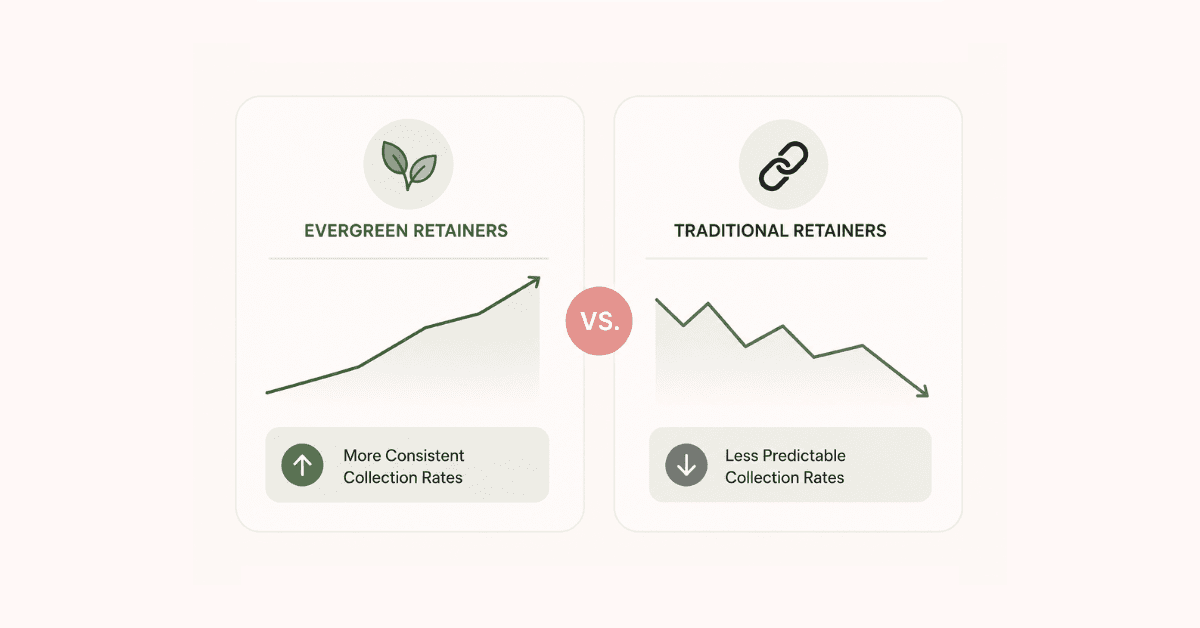
The third is the absence of automation. Most family law firms, particularly small and mid-sized practices, still manage billing manually. No automated payment reminders. No real-time AR dashboard. No system that flags an aging invoice before it becomes a collection problem. Firms that send automated payment reminders get paid an average of 15 days faster. That's not a feature, it's a structural advantage that most firms simply don't have.
Separating the Emotional from the Operational
The most effective thing a family law attorney can do to protect themselves, financially and emotionally, is to remove as much of the billing function from personal judgment as possible.
This means building systems that act independently of how the attorney feels about the client on a given week. Automated invoice reminders that go out at 14 and 30 days without anyone having to decide to send them. Retainer replenishment triggers that are written into the engagement letter, not negotiated case by case. A clear internal protocol that activates at 45 days overdue, before the balance has grown to a point where collection feels impossible.
When the system handles the initial follow-up, the attorney is no longer the one making the first uncomfortable call. That boundary matters. It also tends to produce better outcomes: clients who receive consistent, automated billing communication are less surprised by what they owe and more likely to stay current.
Knowing When to Have the Direct Conversation
None of this eliminates the need for direct human intervention, it just preserves it for the moments where it's actually necessary. When an invoice has passed the automated follow-up window and remains unpaid, that's the signal for a partner-level call. Not a billing administrator, not an email. A direct conversation that acknowledges the situation, offers a structured payment plan if appropriate, and is clear about what happens if the balance continues to go unaddressed.
Payment plans, when documented in writing with specific amounts and due dates, recover more revenue than collection agencies and are far less likely to damage the client relationship permanently. The key is offering them before the balance becomes adversarial.
Knowing how to collect unpaid invoices from law firm clients requires this combination: systems that handle the routine, and attorneys who engage personally when the situation demands it. Conflating the two, that is, asking attorneys to personally manage every billing touchpoint guarantees that follow-up will be inconsistent, emotionally costly, and delayed.
The Bottom Line
The client who won't pay is a fact of family law practice. What varies is how much it costs the attorney both financially and personally, and how much of that cost is preventable.
Most of the damage comes not from the non-payment itself but from the delay before it's addressed. Every week a 90-day invoice sits without follow-up is a week the probability of collection drops. Every engagement that starts without clear retainer replenishment terms is a case the attorney may end up funding themselves.
The emotional toll is real. The financial toll is measurable. And both are, in large part, the downstream consequences of systems that haven't been built yet.
The firms that invest in family law billing automation such as, AR dashboards, automated reminders, retainer tracking, don't just collect more. Their attorneys carry less.

" height="16.57165px" id="usoExa717" transform="translate(1 2)" width="18.33337px"/></svg>)
" height="19.996073000000003px" id="slKA4m0c7" transform="translate(0 0)" width="19.9883px"/><path d="M 5.137 0 C 2.301 0 0 2.301 0 5.137 C 0 7.973 2.301 10.273 5.137 10.273 C 7.973 10.273 10.273 7.973 10.273 5.137 C 10.273 2.301 7.973 0 5.137 0 Z M 5.137 8.469 C 3.297 8.469 1.805 6.977 1.805 5.137 C 1.805 3.297 3.297 1.805 5.137 1.805 C 6.977 1.805 8.469 3.297 8.469 5.137 C 8.469 6.977 6.977 8.469 5.137 8.469 Z" fill="rgb(232, 124, 124)" height="10.273390000000001px" id="QoooNkCCR" transform="translate(4.863 4.863)" width="10.27342px"/><path d="M 2.399 1.199 C 2.399 1.863 1.859 2.398 1.199 2.398 C 0.535 2.398 0 1.859 0 1.199 C 0 0.535 0.539 0 1.199 0 C 1.859 0 2.399 0.539 2.399 1.199 Z" fill="rgb(232, 124, 124)" height="2.3984400000000003px" id="QF02FX4CF" transform="translate(14.141 3.461)" width="2.398500000000002px"/></g></svg>)
" height="19.999972999999997px" id="cGbUHvSUM" transform="translate(0 0)" width="20px"/></g></svg>)