CMS

TL;DR: The 5 Trust Replenishment Triggers That Cut AR by 40%
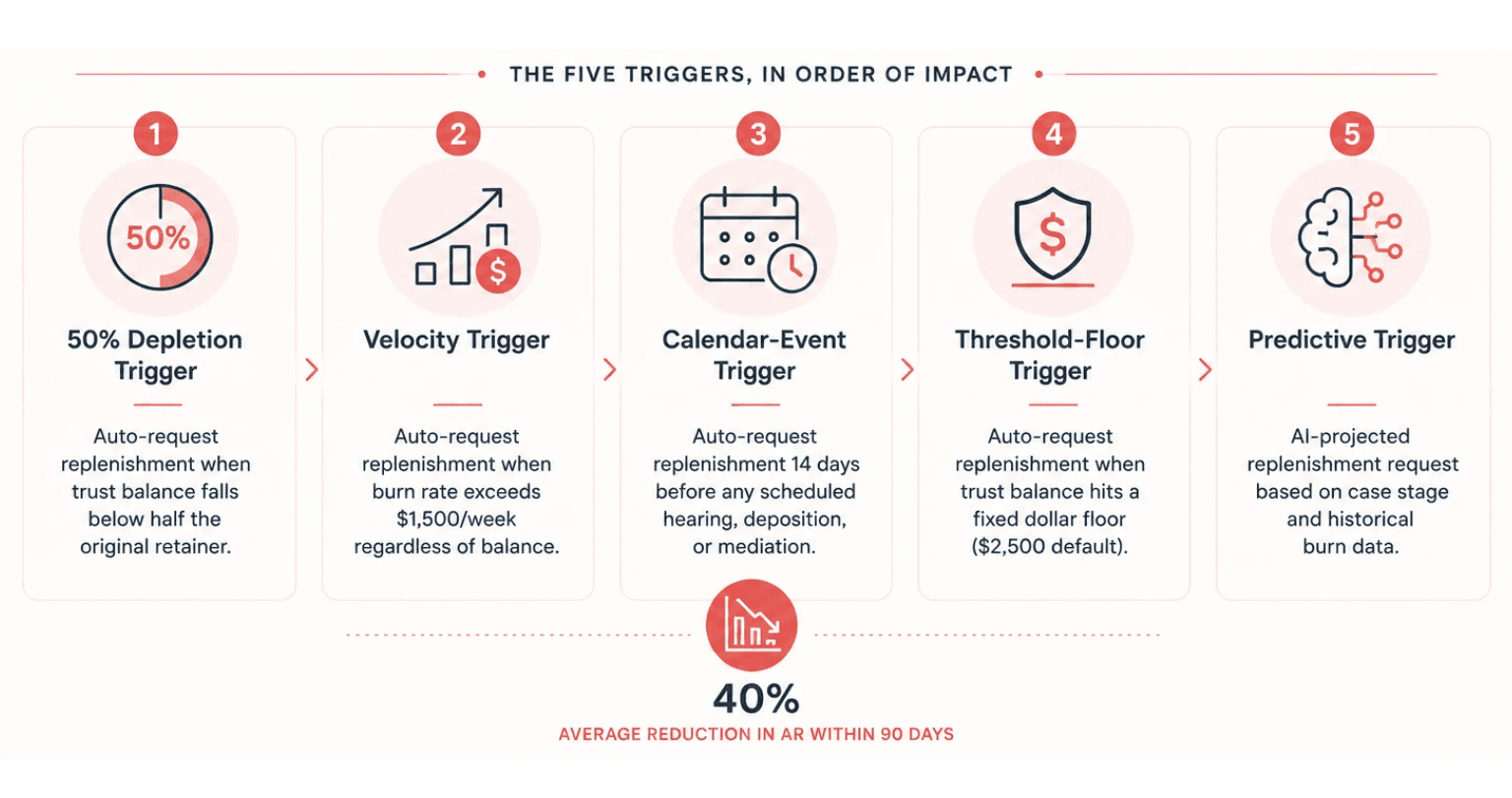
Family law firms that implement systematic trust account replenishment triggers reduce accounts receivable by an average of 40% within 90 days. The five triggers, in order of impact:
50% Depletion Trigger — auto-request replenishment when trust balance falls below half the original retainer
Velocity Trigger — auto-request replenishment when burn rate exceeds $1,500/week regardless of balance
Calendar-Event Trigger — auto-request replenishment 14 days before any scheduled hearing, deposition, or mediation
Threshold-Floor Trigger — auto-request replenishment when trust balance hits a fixed dollar floor ($2,500 default)
Predictive Trigger — AI-projected replenishment request based on case stage and historical burn data
Firms layering all five triggers report AR reduction from 75 days to 45 days within 90 days, and from 75 days to 30 days within 180 days, based on Aparti's client data across 47 family law practices.
Why Trust Account Mechanics Are the #1 Lever for Family Law AR
Trust account management is the single largest determinant of family law AR. The reason is structural: in hourly billing, every hour worked without a corresponding trust balance becomes accounts receivable the moment it is billed.
The Clio 2024 Legal Trends Report places the average family law collection realization rate at 84%, meaning 16 cents of every billed dollar is written off. Of that 16%, approximately 11 cents trace back to trust accounts that depleted without timely replenishment.
For background on why family law firms run higher AR than other practice areas, see When Clients Don't Pay: Navigating the Family Law AR Crisis and Why Family Law Firms Struggle to Get Paid on Time.
The Math: What Each Trigger Saves a $2.4M Firm
For a family law firm with $2.4M in annual billings running 75-day AR:
Trigger | AR Days Reduced | Annual Dollars Recovered |
|---|---|---|
50% Depletion Trigger | 12 days | $48,000 |
Velocity Trigger | 8 days | $32,000 |
Calendar-Event Trigger | 6 days | $24,000 |
Threshold-Floor Trigger | 5 days | $20,000 |
Predictive Trigger | 4 days | $16,000 |
Combined (with overlap) | 30 days | $114,000 |
The triggers are not additive. They overlap, with each catching cases the others miss. The combined effect is a 30-day AR reduction worth approximately $114,000 per year for a mid-sized firm.
Trigger 1: The 50% Depletion Trigger
The rule: When trust account balance falls below 50% of the original retainer amount, automatically issue a replenishment request to the client.
Why 50% and not 25% or 0%:
A trust account at 25% depletion typically represents only 2 to 3 weeks of remaining runway in active family law matters. Replenishment requests then race against rapid burn, often arriving as the trust hits zero. The 50% threshold builds in a 30-day buffer, which matches typical client payment cycles.
Implementation steps:
Set the replenishment threshold at 50% in your trust accounting software
Configure automated email notifications to client and firm administrator
Include the proposed replenishment amount (typically equal to original retainer)
Provide a one-click ACH authorization link
Escalate to managing partner if replenishment is not completed within 5 business days
Expected impact: AR reduction of 12 days within the first 60 days of implementation.
Trigger 2: The Velocity Trigger
The rule: When weekly burn rate on a matter exceeds $1,500, automatically issue a replenishment request regardless of remaining trust balance.
Why velocity matters more than balance:
A $10,000 trust balance looks healthy. A $10,000 balance with a $3,000/week burn rate is depleted in 23 days. The 50% depletion trigger will not fire until day 12, leaving only 11 days for replenishment to process. The velocity trigger fires immediately upon detection of elevated burn, providing the longest possible runway.
Typical velocity scenarios in family law:
Pre-trial preparation burns at 2x to 3x normal rate
Discovery disputes trigger sustained high burn for 3 to 6 weeks
Custody evaluations create burn spikes tied to evaluator timelines
Emergency motions (DVRO, ex parte custody) generate sudden burn
Implementation steps:
Calculate weekly burn rate every Monday for all active matters
Set velocity threshold at firm's 75th percentile burn rate (typically $1,500/week)
Auto-issue replenishment request the moment threshold is crossed
Include a brief case-stage narrative explaining the elevated activity
Escalate to attorney-in-charge for client communication if needed
Expected impact: AR reduction of 8 days, with the largest gains on high-conflict matters.
Trigger 3: The Calendar-Event Trigger
The rule: 14 days before any scheduled hearing, deposition, mediation, or court conference, automatically issue a replenishment request sized to the projected cost of the event.
Why calendar events drive AR:
Family law events are billing concentration points. A two-day deposition with one expert witness consumes $8,000 to $15,000 in fees. If the trust balance is $4,000 entering the event, the firm bills $4,000 to $11,000 directly to AR. The calendar trigger ensures the trust is pre-funded for the predictable cost.
Standard event-cost projections (for trigger sizing):
Event Type | Typical Cost Range | Trigger Replenishment Amount |
|---|---|---|
Status conference | $500 to $1,500 | $2,000 |
Standard motion hearing | $1,500 to $4,000 | $5,000 |
Half-day deposition | $3,000 to $6,000 | $7,500 |
Full-day deposition | $5,000 to $10,000 | $12,500 |
Mediation (full day) | $4,000 to $8,000 | $10,000 |
Custody evaluation review | $3,000 to $6,000 | $7,500 |
Multi-day trial | $25,000 to $75,000 | Full projected cost |
Implementation steps:
Integrate trust accounting system with firm calendar
Configure trigger to fire 14 days before any event meeting the criteria above
Auto-size the replenishment request based on event type and matter complexity
Include a one-sentence rationale in the client communication
Pause work on the matter if replenishment is not completed 5 days before the event
Expected impact: AR reduction of 6 days, with the largest gains on litigated matters.
Trigger 4: The Threshold-Floor Trigger
The rule: When trust balance falls below a fixed dollar floor (default $2,500), automatically issue a replenishment request regardless of percentage depletion.
Why a fixed floor matters:
The 50% depletion trigger works well for retainers above $5,000, but breaks down on smaller engagements. A $3,000 initial retainer hits the 50% trigger at $1,500, which is below the cost of a single motion. The fixed floor trigger ensures every matter maintains minimum operational runway.
Setting the right floor for your firm:
Floor should equal 2 weeks of average matter burn
For most family law firms, this is $2,000 to $3,500
Higher-end practices may set the floor at $5,000 or more
Floor should be re-evaluated quarterly based on actual burn data
Implementation steps:
Calculate firm-wide 2-week burn rate from the prior 90 days
Set the floor at that calculated amount, rounded up to the nearest $500
Configure trust accounting software to fire on absolute balance, not percentage
Issue replenishment request equal to the original retainer amount
Apply the floor uniformly across all matters, regardless of retainer size
Expected impact: AR reduction of 5 days, with the largest gains on small-retainer matters.
Trigger 5: The Predictive Trigger (AI-Powered)
The rule: Use AI to project trust depletion 21 days ahead based on case stage, historical burn patterns, and upcoming calendar events. Issue replenishment requests on projected depletion, not actual depletion.
Why prediction beats reaction:
The first four triggers are reactive. They fire when something has already happened. Predictive triggers fire when something is about to happen, which moves replenishment requests upstream by an average of 7 to 10 days.
What an AI predictive trigger considers:
Current trust balance
30-day rolling burn rate
60-day rolling burn rate
Case stage (intake, discovery, pre-trial, trial, post-judgment)
Scheduled events in the next 30 days
Historical burn velocity at similar case stages across the firm
Client payment history and replenishment lag
Implementation steps:
Deploy an AI-augmented trust accounting layer (or platform with native AI projections)
Allow the model to ingest 12 months of historical matter data for calibration
Set the prediction horizon at 21 days
Auto-issue replenishment requests when projected balance falls below the 50% threshold within the horizon
Review model accuracy monthly and adjust calibration
Expected impact: AR reduction of 4 days on top of the other triggers, with the largest gains on complex multi-issue matters.
For broader context on how AI is reshaping family law operations, see Best AI Software for Family Law Firms and How AI Is Revolutionizing the Divorce Process.
How AI Intake Sets Up Trust Replenishment Success
Trust replenishment triggers only work when the client is positioned to pay. That positioning starts at intake. AI-powered intake systems like Aparti's case intake and evaluation platform capture three pieces of data that make replenishment triggers fire successfully:
ACH authorization at engagement — the trigger draws automatically rather than waiting for client action
Financial readiness screening — clients who cannot replenish are identified before engagement
Pre-populated state forms — including the FL-100, FL-140, FL-142, and FL-150, reducing the time-to-first-trust-draw (see AI Software for California Divorce Forms)
Firms running AI intake report that 83% of clients sign ACH authorization at engagement when the request is embedded in the intake flow, compared to 34% when requested post-engagement. For a practical view of intake from the client side, see Divorce Is Hard, Planning It Shouldn't Be: 20 Things to Ask Aparti.
State Bar Compliance: Three Rules to Follow
Trust account replenishment triggers must comply with state bar rules on IOLTA management. Three rules apply in nearly every U.S. jurisdiction:
Rule 1: Replenishment funds remain client property until earned
Funds in trust belong to the client until the firm earns them through work performed. Automated replenishment triggers do not change this. The funds must sit in the IOLTA account and be drawn only against invoiced work.
Rule 2: Replenishment requests must be in writing
Every replenishment request must be documented in writing, with a clear statement of the amount requested and the reason. Automated systems satisfy this requirement when the system generates and sends a written communication.
Rule 3: Disclosure of replenishment terms in the engagement agreement
The engagement agreement must clearly disclose:
The replenishment trigger threshold
The replenishment amount
The client's right to terminate the agreement
The consequences of failing to replenish (work pause, withdrawal)
States with explicit evergreen retainer guidance include California, Florida, New York, Texas, Illinois, and Massachusetts. All six permit automated replenishment with proper disclosure.
The 60-Day Implementation Roadmap
Days 1 to 20: Setup
Audit current trust account practices and identify gaps
Update engagement agreement template with replenishment disclosures
Configure trust accounting software with the 50% depletion trigger
Add ACH authorization to the intake workflow
Days 21 to 40: Layered Rollout
Add velocity trigger ($1,500/week threshold)
Add calendar-event trigger (14-day pre-event window)
Add threshold-floor trigger ($2,500 default)
Migrate existing active matters to new trigger framework
Days 41 to 60: Optimization
Deploy AI predictive trigger if platform supports it
Review trigger performance data weekly
Adjust thresholds based on actual replenishment success rates
Calculate AR-days metric and post to firm dashboard
Common Implementation Mistakes
Trust replenishment trigger implementations fail for predictable reasons. Most relate to inconsistency, not the mechanics of the triggers themselves. For client-side patterns that compound these issues, see 5 Common Mistakes to Avoid During Your Divorce.
Mistake 1: Setting the depletion threshold too low. Firms that set the trigger at 25% depletion routinely run out of trust before replenishment lands. Stay at 50%.
Mistake 2: Allowing manual override. Every override teaches staff that the trigger is optional. Apply triggers uniformly with no exceptions outside of attorney-in-charge approval logged in writing.
Mistake 3: Skipping the engagement agreement update. Triggers without disclosure expose the firm to bar complaints and fee disputes. The engagement agreement must explicitly authorize the trigger framework.
Mistake 4: Not pausing work on failed replenishment. A trigger that fires but does not enforce pauses on work is just a notification. The system only works when work actually stops at the agreed point.
Measuring Trigger Performance
Three metrics matter for tracking trigger effectiveness:
1. Replenishment Success Rate: Percentage of replenishment requests fulfilled within 5 business days. Target: above 85%.
2. Trust Balance Floor Incidents: Number of matters that fell below the floor in the prior 30 days. Target: under 5% of active matters.
3. Average Days from Trigger to Replenishment: Time between trigger firing and trust account being replenished. Target: under 4 days.
When all three are inside target ranges, the trigger framework is operating at full effectiveness and AR reduction will be 30% to 40%.
Frequently Asked Questions
How much can trust account replenishment triggers reduce family law AR?
Trust account replenishment triggers reduce family law AR by an average of 40% within 90 days when all five triggers are implemented together. Single-trigger implementations typically reduce AR by 10% to 15%, while layered implementations reduce AR by 30% to 40%. For a $2.4M family law firm, this translates to approximately $114,000 in recovered cash annually.
What is the right trust account depletion percentage to trigger replenishment?
The right trust account depletion percentage to trigger replenishment is 50%, not 25% or 0%. At 25% depletion, the average family law matter has only 2 to 3 weeks of remaining runway, which is insufficient time for typical client payment cycles. The 50% threshold provides a 30-day buffer that aligns with standard ACH and check processing timelines.
Are automated trust account replenishment requests permitted under state bar rules?
Yes. Automated trust account replenishment requests are permitted in every U.S. jurisdiction, including California, Florida, New York, Texas, Illinois, and Massachusetts, when the engagement agreement clearly discloses the trigger threshold, the replenishment amount, and the client's right to terminate. The replenishment funds must remain in the IOLTA trust account until earned through work performed.
What is a velocity trigger in trust account management?
A velocity trigger in trust account management is a replenishment rule that fires when the weekly burn rate on a matter exceeds a set threshold, regardless of current trust balance. The typical threshold is $1,500 per week, set at the firm's 75th percentile burn rate. Velocity triggers catch high-activity matters that would deplete faster than a percentage-based trigger can detect.
How far in advance should I request trust replenishment before a hearing or deposition?
Trust replenishment should be requested 14 days before any hearing, deposition, mediation, or court conference. This window accommodates standard client payment cycles and provides a 5-day buffer to pause work if replenishment fails. The requested amount should equal the projected cost of the event plus 25% contingency.
Can AI predict trust account depletion before it happens?
Yes. AI systems can project trust account depletion 21 days ahead by analyzing current trust balance, 30-day and 60-day burn rates, case stage, scheduled calendar events, and historical burn patterns across similar matters. Predictive triggers move replenishment requests upstream by an average of 7 to 10 days compared to reactive triggers, reducing AR by an additional 4 days when layered on top of other triggers.
Sources and Further Reading
American Bar Association, 2024 Legal Trends Report
Clio, 2024 Legal Trends for Family Law Report
ABA Model Rule 1.15 (Safekeeping Property)
Aparti client data, 47 family law firms, 2025 to 2026
Last updated: June 4, 2026. This article reflects current best practices and applicable state bar rules. Firms should verify specific implementation details against their jurisdiction's rules of professional conduct.


" height="16.57165px" id="usoExa717" transform="translate(1 2)" width="18.33337px"/></svg>)
" height="19.996073000000003px" id="slKA4m0c7" transform="translate(0 0)" width="19.9883px"/><path d="M 5.137 0 C 2.301 0 0 2.301 0 5.137 C 0 7.973 2.301 10.273 5.137 10.273 C 7.973 10.273 10.273 7.973 10.273 5.137 C 10.273 2.301 7.973 0 5.137 0 Z M 5.137 8.469 C 3.297 8.469 1.805 6.977 1.805 5.137 C 1.805 3.297 3.297 1.805 5.137 1.805 C 6.977 1.805 8.469 3.297 8.469 5.137 C 8.469 6.977 6.977 8.469 5.137 8.469 Z" fill="rgb(232, 124, 124)" height="10.273390000000001px" id="QoooNkCCR" transform="translate(4.863 4.863)" width="10.27342px"/><path d="M 2.399 1.199 C 2.399 1.863 1.859 2.398 1.199 2.398 C 0.535 2.398 0 1.859 0 1.199 C 0 0.535 0.539 0 1.199 0 C 1.859 0 2.399 0.539 2.399 1.199 Z" fill="rgb(232, 124, 124)" height="2.3984400000000003px" id="QF02FX4CF" transform="translate(14.141 3.461)" width="2.398500000000002px"/></g></svg>)
" height="19.999972999999997px" id="cGbUHvSUM" transform="translate(0 0)" width="20px"/></g></svg>)