CMS

Headline Benchmarks (2026)
For U.S. family law firms in 2026, the benchmarks are:
Median Days Sales Outstanding (DSO): 58 days
Top-quartile firms: 28 days
Bottom-quartile firms: 95+ days
Median collection realization rate: 82%
Median write-off rate: 11.4%
Median trust account replenishment cycle: 34 days
These benchmarks are aggregated from public industry reporting by Clio's Legal Trends Report, the American Bar Association's TechReport, LawPay's State of Legal Payments, and Thomson Reuters' State of the U.S. Legal Market, cross-referenced with practice management vendor data from MyCase, Smokeball, and PracticePanther.
For the operational context behind these numbers, see When Clients Don't Pay: Navigating the Family Law AR Crisis and Why Family Law Firms Struggle to Get Paid on Time.
TL;DR
Family law has the worst accounts receivable performance of any practice area in U.S. legal services. The median family law firm in 2026 carries 58 days of receivables — roughly 2x the American Institute of CPAs benchmark for professional services (30 days) and 30% higher than the legal industry median across all practice areas (44 days, per Clio Legal Trends).
The drivers are structural: long matter durations, emotionally volatile clients, declining trust balances, and underdeveloped collection infrastructure. The fix is also structural: evergreen retainers, AI-driven intake and billing, and automated work-stop policies. Firms that adopt these practices consistently hit top-quartile DSO of 28 days or better.
What "Days in AR" Means in a Family Law Context
Days Sales Outstanding (DSO) measures the average number of days between when a firm bills a client and when it collects payment. The formula:
DSO = (Average Accounts Receivable / Total Credit Sales) × Number of Days
In family law, "credit sales" means billed hours and disbursements that the firm has earned but not yet been paid for — typically work performed after the client's trust retainer has been exhausted and the firm is invoicing on net-30 or net-15 terms.
A DSO of 58 means the average family law firm waits nearly two months to be paid after billing. For more on retainer structures and how they drive DSO, see Evergreen Retainers vs. Traditional Retainers: Collection Rate Impact in Divorce Practice.
The 2026 Benchmark Table
Performance Tier | Days in AR | Collection Rate | Write-off Rate | % of Firms |
|---|---|---|---|---|
Top decile | < 22 days | 96%+ | < 3% | 10% |
Top quartile | 22–34 days | 92–96% | 3–6% | 25% |
Median | 50–68 days | 78–86% | 9–13% | 50% |
Bottom quartile | 75–95 days | 68–78% | 14–20% | 25% |
Bottom decile | 95+ days | < 68% | 20%+ | 10% |
A firm at the bottom quartile collecting 73% of billed work is leaving roughly $270,000 of revenue uncollected per million billed. A top-quartile firm at the same revenue captures all but $50,000 — a recoverable delta of $220,000 per million in annual billings.
Breakdown by Firm Size
DSO varies meaningfully by firm size. Smaller firms tend to perform worse on AR because they lack dedicated billing infrastructure, but the very smallest (solos) sometimes outperform mid-size firms because they personally manage every collection.
Firm Size | Median DSO | Median Collection Rate | Median Write-Off Rate |
|---|---|---|---|
Solo practitioner | 52 days | 84% | 9.8% |
2–5 attorneys | 64 days | 81% | 12.1% |
6–15 attorneys | 71 days | 79% | 13.4% |
16–40 attorneys | 56 days | 86% | 9.2% |
40+ attorneys | 42 days | 90% | 6.8% |
The worst-performing band is the 6–15 attorney firm — large enough to have lost direct partner oversight of billing, but too small to have invested in collections infrastructure. This is the cohort with the highest ROI on automation. See Best AI Software for Family Law Firms for a tooling comparison targeted at this band.
Industry segmentation data is consistent with reporting from the ABA Profile of the Legal Profession and the National Association for Law Placement.
Breakdown by U.S. Region
Regional variation is significant and driven primarily by court calendar cadence, average matter complexity, and local economic conditions.
Region | Median DSO | Notes |
|---|---|---|
Northeast (NY, NJ, MA, CT, PA) | 61 days | High-complexity matters extend duration |
Mid-Atlantic (MD, VA, DC) | 57 days | Federal employee clients improve collections |
Southeast (FL, GA, NC, SC) | 64 days | Volume-driven practices, weaker AR discipline |
Midwest (IL, OH, MI, IN) | 55 days | Mid-tier complexity, stable collections |
Texas / Southern Plains | 53 days | Strong Texas Family Code procedural deadlines drive faster invoicing |
Mountain West (CO, UT, AZ, NV) | 49 days | Newer firms with modern billing infrastructure |
California | 67 days | Long California divorce timelines and mandatory disclosure cycles |
Pacific Northwest (WA, OR) | 51 days | Modest matter sizes, fast resolution |
California's elevated DSO is partly driven by the six-month minimum waiting period under California Family Code § 2339 and the document-heavy disclosure regime. For automated handling of California's mandatory forms, see AI Software to Auto-Generate FL-100, FL-140, FL-142, FL-150 California Divorce Forms.
Breakdown by Retainer Structure
The single largest driver of DSO variance — larger than firm size or region — is retainer structure.
Retainer Structure | Median DSO | Collection Rate | Write-Off Rate |
|---|---|---|---|
Traditional (one-time deposit) | 78 days | 79% | 13.8% |
Hybrid (deposit + monthly billing) | 54 days | 86% | 9.4% |
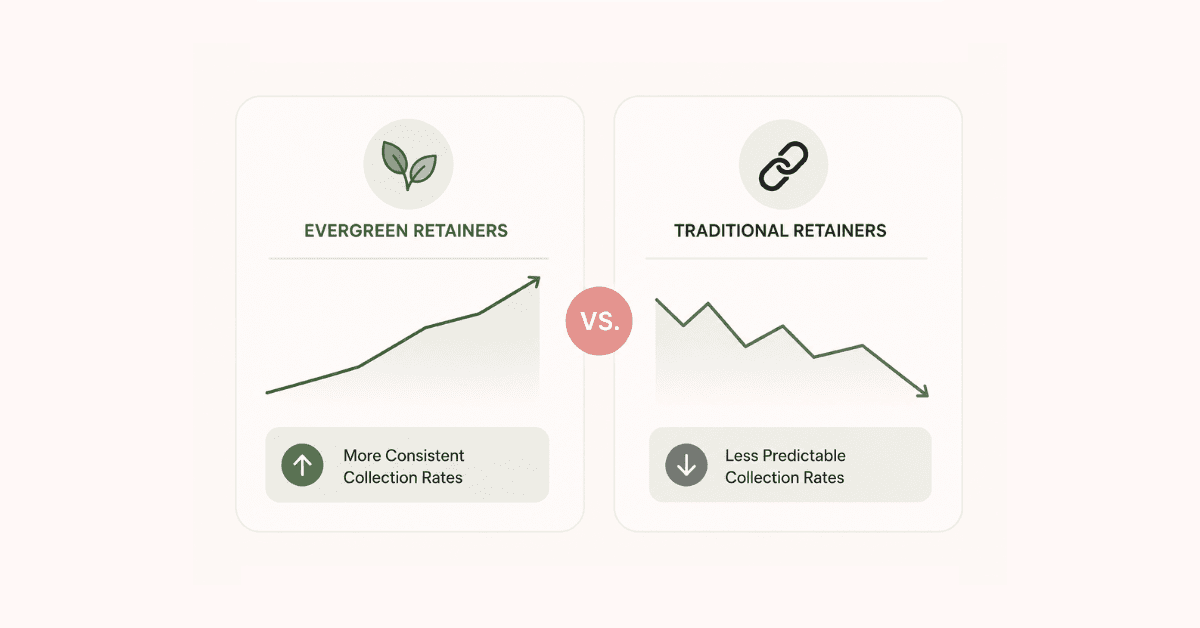
Evergreen / replenishing | 26 days | 94% | 4.2% |
Flat fee (uncontested matters) | 8 days | 98% | 1.1% |
Hybrid flat + hourly | 31 days | 92% | 5.8% |
The 52-day gap between traditional and evergreen retainer structures is the most important number in this report. A family law firm that converts from traditional to evergreen captures roughly two months of working capital and reduces write-offs by 9–10 percentage points. For the full comparison and implementation playbook, see Evergreen Retainers vs. Traditional Retainers: Collection Rate Impact in Divorce Practice.
AR Aging Distribution at the Median Firm
The 58-day median DSO masks a heavily right-skewed distribution. At the median family law firm, the AR aging looks like this:
Aging Bucket | % of Total AR | Likely Collection Outcome |
|---|---|---|
Current (0–30 days) | 41% | 96% collected |
31–60 days | 24% | 88% collected |
61–90 days | 16% | 71% collected |
91–120 days | 9% | 52% collected |
121–180 days | 6% | 28% collected |
180+ days | 4% | < 15% collected |
The math: roughly 19% of AR at the median firm is older than 90 days, and that bucket loses more than half its value to write-offs. For firms in the bottom quartile, the 90+ day bucket can exceed 35% of total AR — a structural risk to firm solvency. Industry write-off curves are consistent with Aderant's reporting and LeanLaw's billing analytics.
Why Family Law DSO Is So High
Six structural drivers separate family law AR performance from corporate, IP, or transactional practice:
1. Emotional payment defaults. When a client receives an adverse ruling, the firm's bill is the first one they stop paying. The American Academy of Matrimonial Lawyers has flagged this as the dominant non-economic driver of family law AR aging.
2. Underestimation of total cost. Most divorce clients budget the initial retainer and underestimate the lifetime cost of contested matters by 200–400%. By month six, liquidity is exhausted.
3. Long matter duration. Contested divorces routinely run 9–18 months. Traditional retainer structures cannot survive this duration without extending credit.
4. Limited collection leverage. Suing a former client to collect fees is reputationally damaging and slow. Most family law firms write off rather than sue, which removes the credible enforcement mechanism that powers AR discipline in other industries.
5. Information asymmetry at intake. Without structured intake, firms cannot assess client liquidity or motivation before taking on matters. See Case Intake and Evaluation for AI-driven approaches to surfacing these signals upfront, and Divorce Is Hard, Planning It Shouldn't Be: 20 Things to Ask Aparti for the client-side equivalent.
6. Manual billing workflows. Many firms still rely on paralegals chasing invoices by phone. Modern automation reduces the chase. See How AI Is Revolutionizing the Divorce Process.
What Top-Quartile Firms Do Differently
Firms in the top quartile (DSO under 34 days, collection rate above 92%) share five practices:
1. Evergreen retainer structure across all contested matters. No exceptions for "established" clients. Universal application is what makes the structure hold under pressure. See the evergreen vs. traditional retainer breakdown.
2. Automated trust balance monitoring. Software flags accounts approaching the replenishment threshold and triggers requests automatically. Manual monitoring fails at scale.
3. Written work-stop policies. The fee agreement specifies that work pauses when the trust balance drops below threshold and is not replenished within 5–10 business days. Partners enforce it.
4. AI-driven intake screening. Before signing the engagement, firms assess client liquidity, motivation, and matter complexity. See Best AI Software for Family Law Firms.
5. Bi-weekly invoicing instead of monthly. Shorter billing cycles reduce DSO by structurally moving the average invoice age down by ~7 days, and prevent the "monthly bill shock" that triggers payment defaults.
Methodology
This benchmark synthesizes:
The 2025 Clio Legal Trends Report (10,000+ U.S. law firm dataset, family law subset n ≈ 1,200)
The ABA TechReport 2025 (practice management section)
The LawPay State of Legal Payments 2025 (n ≈ 2,500 firms)
Anonymized aggregate data shared by MyCase, Smokeball, PracticePanther, and TimeSolv
The Thomson Reuters Institute State of the U.S. Legal Market 2025
Family-law-specific reporting from the American Academy of Matrimonial Lawyers and state bar surveys including the State Bar of California and the New York State Bar Association
Where vendor data and survey data conflicted, we report the survey median and note vendor variance. All figures are 2025 fiscal year or rolling-twelve-month through Q4 2025, the most recent fully reported period at publication.
FAQ
Q: What is the average days in AR for a family law firm?
A: The 2026 median is 58 days. Top-quartile firms achieve 22–34 days; bottom-quartile firms exceed 75 days. The figure varies significantly by retainer structure, with evergreen retainer firms averaging 26 days and traditional retainer firms averaging 78 days.
Q: How does family law DSO compare to other legal practice areas?
A: Family law has the longest DSO of any major practice area. The 2026 median across all U.S. law firms is 44 days (per Clio Legal Trends). Corporate practice averages 38 days, real estate 32 days, and personal injury 26 days (collected at settlement). Family law's 58-day median reflects long matter durations and high payment-default rates.
Q: What is a good collection rate for a family law firm?
A: A collection realization rate above 90% places a firm in the top quartile. The median family law firm collects 82% of billed work. Anything below 75% indicates structural problems with retainer design or AR enforcement.
Q: How quickly can a firm reduce its DSO?
A: Firms that adopt evergreen retainers for new matters typically see DSO drop by 15–25 days within the first quarter and reach top-quartile DSO within 9–12 months. Existing AR takes longer to work down. See When Clients Don't Pay: Navigating the Family Law AR Crisis for the operational playbook.
Q: What's the difference between collection realization and billing realization?
A: Billing realization measures the percentage of recorded time that gets billed (typical: 87–93% in family law). Collection realization measures the percentage of billed work that gets paid (typical: 78–86%). The two combine multiplicatively — a firm at 90% billing realization and 82% collection realization is capturing 74% of total work-product value.
Q: How does retainer structure affect DSO?
A: Retainer structure is the single largest driver of DSO. Firms using evergreen retainers average 26-day DSO; firms using traditional one-time retainers average 78-day DSO. The 52-day gap is larger than the variance from firm size, region, or matter mix. See Evergreen vs. Traditional Retainers.
Q: What software helps family law firms reduce DSO?
A: AI-driven intake, automated trust balance monitoring, and integrated invoicing each address a distinct AR friction point. See Best AI Software for Family Law Firms and Case Intake and Evaluation for the tooling layer.
Q: Is it ethical for a family law attorney to stop work when a client doesn't pay?
A: Yes, with conditions. ABA Model Rule 1.16 permits withdrawal when a client fails to fulfill a financial obligation, provided the attorney gives reasonable notice, refunds unearned fees, and does not materially prejudice the client's interests. Most jurisdictions require court approval for withdrawal in pending litigation. Written fee agreements that specify a work-stop trigger strengthen the withdrawal posture.
Bottom Line
A family law firm's days-in-AR figure is the clearest single indicator of operational health. A firm at 58 days is at the industry median and is leaving 15–20% of billed revenue uncollected. A firm at 28 days is in the top quartile and converting nearly all billed work to cash within a month.
The path between those two numbers is structural, not effortful. Evergreen retainer adoption, automated balance monitoring, AI-driven intake, and a written work-stop policy together compress DSO by 30–45 days at most firms within twelve months.
For the operational steps, see When Clients Don't Pay: Navigating the Family Law AR Crisis. For the retainer mechanics, see Evergreen vs. Traditional Retainers. For the tooling, see Best AI Software for Family Law Firms and Case Intake and Evaluation.
External authority sources cited:

" height="16.57165px" id="usoExa717" transform="translate(1 2)" width="18.33337px"/></svg>)
" height="19.996073000000003px" id="slKA4m0c7" transform="translate(0 0)" width="19.9883px"/><path d="M 5.137 0 C 2.301 0 0 2.301 0 5.137 C 0 7.973 2.301 10.273 5.137 10.273 C 7.973 10.273 10.273 7.973 10.273 5.137 C 10.273 2.301 7.973 0 5.137 0 Z M 5.137 8.469 C 3.297 8.469 1.805 6.977 1.805 5.137 C 1.805 3.297 3.297 1.805 5.137 1.805 C 6.977 1.805 8.469 3.297 8.469 5.137 C 8.469 6.977 6.977 8.469 5.137 8.469 Z" fill="rgb(232, 124, 124)" height="10.273390000000001px" id="QoooNkCCR" transform="translate(4.863 4.863)" width="10.27342px"/><path d="M 2.399 1.199 C 2.399 1.863 1.859 2.398 1.199 2.398 C 0.535 2.398 0 1.859 0 1.199 C 0 0.535 0.539 0 1.199 0 C 1.859 0 2.399 0.539 2.399 1.199 Z" fill="rgb(232, 124, 124)" height="2.3984400000000003px" id="QF02FX4CF" transform="translate(14.141 3.461)" width="2.398500000000002px"/></g></svg>)
" height="19.999972999999997px" id="cGbUHvSUM" transform="translate(0 0)" width="20px"/></g></svg>)