CMS

TL;DR
Pre-bill review is the single most expensive non-billable task in a family law firm. Manual workflows cost partners and senior associates 4–7 hours per week per attorney — roughly 200–360 hours per year of senior time burned on time-entry cleanup, narrative editing, and write-down decisions. Automated pre-bill workflows compress that to 30–45 minutes per week while improving billing realization by 8–12 percentage points and shortening invoice send time from 7–14 days post-cycle to 24–48 hours.
For a 10-attorney family law firm, the annual delta is roughly 2,400 reclaimed billable hours and $180,000–$320,000 in recovered revenue from improved realization alone, before counting the downstream effect on collection rates and DSO.
What Pre-Bill Review Actually Is
Pre-bill review is the workflow between time entry and invoice send. Each draft invoice ("pre-bill") is reviewed by the billing attorney before it goes to the client. The reviewer checks for:
Time entry accuracy — Did the recorded time happen? Is it correctly attributed to the matter?
Narrative quality — Are the descriptions clear, defensible, and client-appropriate?
Block billing flags — Are time entries appropriately broken out?
Rate application — Is the correct billing rate applied for each timekeeper and matter?
Write-down decisions — Should any time be reduced or written off as non-billable?
Disbursement accuracy — Are filing fees, expert costs, and pass-through expenses correctly captured?
Trust application — Should the invoice draw from trust balance or generate net-billing?
Privilege and confidentiality — Does any narrative inadvertently disclose sensitive information?
In a contested family law matter, a single month's pre-bill can contain 80–200 individual time entries across multiple timekeepers, partners, paralegals, and contract attorneys. Each one is a judgment call.
For the broader context on why family law billing is structurally harder than other practice areas, see Why Family Law Firms Struggle to Get Paid on Time.
The Manual Pre-Bill Workflow (Today's Reality)
At most family law firms, the pre-bill workflow looks like this:
Step 1 — Cycle close (day 1). Billing administrator runs the monthly billing cycle in Clio, MyCase, Smokeball, PracticePanther, or TimeSolv. Draft pre-bills are generated for every active matter.
Step 2 — Distribution (days 1–2). Pre-bills are printed or PDF'd and distributed to billing attorneys, either by email, shared folder, or paper packet.
Step 3 — Line-by-line review (days 3–10). Each billing attorney sits with their stack and reviews every entry. For a partner with 12 active matters, this is a 4–6 hour session, typically broken across multiple days because attention degrades after about 90 minutes of pre-bill work.
Step 4 — Markup (concurrent with step 3). The attorney handwrites or types corrections: rewriting narratives, marking write-downs, flagging entries that need explanation, adjusting time values.
Step 5 — Return to billing admin (days 8–12). Marked-up pre-bills go back to the billing administrator, who re-enters the corrections into the practice management system.
Step 6 — Re-review (days 10–14). Corrected pre-bills are regenerated. Some firms require a second review. Many find new errors and loop.
Step 7 — Invoice send (days 12–18). Final invoices go to clients.
Total elapsed time: 12–18 days between cycle close and client invoice. Total attorney time: 4–7 hours per week per partner during the review window. Total billing admin time: 6–10 hours of correction re-entry per cycle.
What Manual Pre-Bill Review Actually Costs
The headline number — 4–7 hours per week per attorney — understates the full cost. Five hidden costs:
1. Opportunity cost on senior time. A partner billing at $550/hour who spends 5 hours per week on pre-bill review is foregoing $2,750 per week, or roughly $130,000 annually, in potential billable work.
2. Delayed invoice send. Every day between cycle close and invoice send adds a day to DSO. A 14-day pre-bill window adds 14 days to the average AR aging curve before the meter even starts. See Average Days in AR for Family Law Firms: The 2026 Benchmark Report for the downstream cost.
3. Fatigue-driven write-downs. Attorneys reviewing pre-bills at hour four of a five-hour session write down more time than they would at hour one. Studies of billing behavior have consistently shown write-down rates increase 15–25% in the second half of long review sessions.
4. Inconsistent narrative quality. Manual review produces high variance in narrative quality across timekeepers and matters, which clients notice. Inconsistent narratives correlate with higher fee disputes.
5. Billing admin re-entry errors. Hand-marked corrections re-keyed by administrators introduce a 2–4% error rate, some of which surfaces in client invoices and damages credibility.
For a firm at the bottom-quartile AR aging profile, the pre-bill workflow is often a meaningful contributor to the problem — not the cause, but a multiplier.
The Automated Pre-Bill Workflow
An automated pre-bill workflow inverts the model. Instead of generating drafts and then having attorneys catch errors, AI-driven systems pre-process every time entry as it is recorded and surface only the entries that require attorney judgment.
Step 1 — Real-time entry validation (continuous). As timekeepers record time, the system checks for: block billing, vague narratives, rate mismatches, matter mis-attribution, duplicate entries, and disbursement coding. Issues are flagged immediately, when context is fresh, rather than weeks later in pre-bill.
Step 2 — Narrative generation and improvement (continuous). AI suggests clearer narratives drawn from matter context, calendar events, document drafts, and email threads. Attorneys approve, edit, or override. The standard family law verbs and phrasings ("conference with client re custody schedule," "draft response to RFP," "review FL-150 supporting docs") are templated and applied consistently.
Step 3 — Cycle close with pre-filtered exceptions (day 1). When the billing cycle closes, the system has already validated 90–95% of entries. The pre-bill packet surfaces only the exceptions — typically 5–10% of entries that require partner judgment.
Step 4 — Exception review (day 1–2). The billing attorney reviews only the flagged entries, typically a 20–40 minute session for a full-month pre-bill across all their matters. Each exception is shown with full context: matter status, client communication history, prior similar entries, and AI-suggested resolution.
Step 5 — One-click approval and send (day 2). Approved pre-bills are finalized and queued for client delivery, often integrated directly with LawPay or Gravity Legal for one-click client payment.
Total elapsed time: 24–48 hours between cycle close and client invoice. Total attorney time: 30–45 minutes per week. Total billing admin time: 1–2 hours per cycle, mostly for edge cases.
For the broader picture on how AI is reshaping family law operations, see Best AI Software for Family Law Firms.
Side-by-Side: Manual vs. Automated
Dimension | Manual Workflow | Automated Workflow | Delta |
|---|---|---|---|
Attorney time per week | 4–7 hours | 30–45 minutes | -85% |
Billing admin time per cycle | 6–10 hours | 1–2 hours | -80% |
Time from cycle close to invoice send | 12–18 days | 1–2 days | -90% |
Billing realization | 87–91% | 95–98% | +8 pts |
Write-down rate (fatigue-driven) | 8–12% of recorded time | 2–4% | -7 pts |
Narrative consistency | High variance | Standardized | Qualitative |
Re-entry errors | 2–4% of corrections | < 0.5% | -3 pts |
DSO impact | +14 days baseline | +2 days baseline | -12 days |
Partner satisfaction with billing | Low | Moderate-High | Qualitative |
Quantifying the Time Savings: A 10-Attorney Firm
Consider a 10-attorney family law firm: 4 partners, 4 senior associates, 2 paralegals (excluded from pre-bill review).
Manual workflow annual cost:
8 attorneys × 5.5 hours/week × 50 weeks = 2,200 hours/year on pre-bill
At blended $400/hour billable rate: $880,000 in foregone billable capacity
Billing admin: 8 hours/cycle × 12 cycles = 96 hours/year at $45/hr = $4,320 direct cost
Delayed invoicing: 12 days extra DSO × $3.2M annual billings × cost of capital ≈ $8,400/year carrying cost
Total manual workflow cost: ~$892,000/year in foregone capacity and direct cost.
Automated workflow annual cost:
8 attorneys × 0.6 hours/week × 50 weeks = 240 hours/year
At $400/hour: $96,000 in foregone capacity
Billing admin: 1.5 hours/cycle × 12 = 18 hours at $45/hr = $810
Tool/software cost: ~$300/user/month × 10 users × 12 = $36,000/year
Total automated workflow cost: ~$133,000/year.
Net annual benefit: ~$759,000 in reclaimed capacity, plus an 8-percentage-point realization improvement (roughly $256,000 in recovered billable value on $3.2M of recorded time).
The transition pays back within the first month for almost every family law firm above 4 attorneys. Below 4 attorneys, the ROI is still positive but the simpler operational baseline reduces the absolute dollar gain. For solo practitioners, the time savings (3–5 hours per week back) often matter more than the realization improvement.
What Automation Can and Cannot Do
What automation handles well:
Block billing detection and breakout suggestions
Narrative standardization across timekeepers and matters
Rate-card application and timekeeper-matter validation
Duplicate entry detection
Disbursement coding consistency
Suggested narratives from calendar, email, and document context
Trust balance application logic
Compliance with state bar billing disclosure rules and matter-specific billing guidelines
What still requires attorney judgment:
Write-down decisions based on case strategy ("don't bill the client for the rabbit-hole I went down")
Sensitive narrative wording in high-conflict matters
Discretionary fee adjustments for client retention
Disputes over time attribution between joint timekeepers
ABA Model Rule 1.5 reasonableness assessments in unusual circumstances
A well-designed automated workflow does not replace attorney judgment — it isolates the entries that require it. The 30–45 minutes per week is spent entirely on judgment calls rather than mechanical review.
The Five-Layer Automated Pre-Bill Stack
A complete automated pre-bill system has five layers. Most firms deploy these incrementally rather than all at once.
Layer 1: Real-Time Time Entry Validation
The first and highest-ROI layer. Catches block billing, vague narratives, and rate mismatches at the moment of entry. Most modern practice management systems offer basic validation; AI-driven layers go further by understanding matter context. See Case Intake and Evaluation for the related upstream layer that ensures the matter is set up for clean billing from day one.
Layer 2: Narrative Generation and Standardization
AI-suggested narratives drawn from calendar events, email threads, document drafts, and prior similar entries. The attorney accepts, edits, or rejects. Over time, the system learns the firm's voice and standard phrasing for common family law tasks (custody negotiations, discovery responses, support calculations, FL-150 drafting).
Layer 3: Exception-Based Pre-Bill Surfacing
Instead of generating full pre-bills for review, the system generates a much smaller exception report. Only entries flagged as ambiguous, anomalous, or requiring partner judgment are surfaced.
Layer 4: One-Click Approval and Send
Direct integration with payment processing (LawPay, Gravity Legal) and trust accounting. Approved pre-bills generate finalized invoices, draw from trust balances as appropriate, and trigger client delivery — all without re-entry.
Layer 5: Post-Bill Learning Loop
The system tracks which entries get disputed, written down, or paid late, and feeds those signals back into the validation and narrative layers. Over 6–12 months, the exception rate drops from ~10% to ~3–5% as the system learns each firm's specific patterns.
Implementation: Moving from Manual to Automated
The transition typically takes 60–90 days for a mid-size family law firm. The sequence:
Weeks 1–2: Baseline measurement. Have every attorney track pre-bill time for two billing cycles. Calculate current hours per attorney per week, current realization rate, current cycle-close-to-invoice-send time, and current write-down rate. Without this baseline, ROI is invisible.
Weeks 3–4: Tool selection. Evaluate AI-driven billing platforms against current practice management system compatibility. Key requirements: real-time validation, narrative generation, exception-based pre-bill surfacing, native integration with the firm's PM system. See Best AI Software for Family Law Firms for the current landscape.
Weeks 5–6: Pilot with 1–2 attorneys. Run parallel workflows: pilot attorneys use the automated system, control attorneys continue manual review. Compare time spent, realization, and error rates.
Weeks 7–10: Firm-wide rollout. Migrate remaining attorneys in cohorts of 2–4. Provide template library training for narrative generation. Establish the new pre-bill review cadence (typically weekly exception review instead of monthly batch review).
Weeks 11–12: Process documentation and policy update. Update billing policies to reflect the new workflow. Document the exception escalation path. Establish ongoing measurement of the same baseline metrics.
Beyond week 12: Learning loop optimization. Track exception rate over time. Track which entries continue to require attorney judgment. Refine the validation rules. Expect the exception rate to fall from ~10% to ~4–5% over the first 6 months.
Common Objections (and Responses)
"Our matters are too unique for automation to understand."
Family law is more pattern-driven than partners typically believe. Across 1,000+ matters, the same 30–40 task types account for over 80% of time entries. Automation excels at the repetitive 80% and surfaces the unique 20% for attorney review — which is exactly the partition you want.
"I don't trust AI-generated narratives going to clients."
Reasonable. The standard workflow has the attorney approve every narrative before send, with edit-in-place. After 60–90 days, most attorneys find they edit fewer than 10% of suggested narratives. The remaining 90% are clearer and more consistent than what they would have written themselves while tired.
"Our billing admin will be redundant."
In practice, billing administrator time shifts from re-entry and chase to client communication, trust accounting compliance, and AR follow-up — all higher-value work. Most firms retain their billing admin and redirect their time to collections workflow, where the human touch genuinely matters.
"What about confidentiality and bar compliance?"
Modern legal AI platforms are built around attorney-client privilege, with on-firm data isolation, no training on client data, and audit trails for every AI suggestion. Confirm specifics with your vendor's compliance documentation and your state bar's relevant ethics opinions on AI use, including the ABA Formal Opinion 512 framework on generative AI in legal practice.
"We tried billing software before and it didn't help."
Legacy billing software automates the invoice generation step but leaves the review burden untouched. The shift in 2025–2026 is real-time validation and exception-based review — a structurally different workflow, not a faster version of the old one.
Bar and Ethics Considerations
Pre-bill review automation interacts with three core ethics rules:
**ABA Model Rule 1.5 — Fees:** Fees must be reasonable. Automation does not change this standard, but it can improve documentation defensibility — every narrative is generated from contemporaneous matter context with an audit trail.
**ABA Model Rule 1.6 — Confidentiality:** Client information processed by AI billing systems must remain confidential. Verify vendor data isolation and contractual confidentiality terms.
**ABA Model Rule 5.3 — Responsibilities Regarding Nonlawyer Assistance:** AI is treated as a non-lawyer assistant. The supervising attorney is responsible for the work product. Automated workflows must preserve attorney oversight — which exception-based review accomplishes by design.
Consult your state bar's most recent ethics opinions on AI; many state bars (including the State Bar of California, the New York State Bar Association, and the Florida Bar) have published practical guidance since 2024.
FAQ
Q: How many hours per week does pre-bill review actually take for family law attorneys?
A: At firms using manual workflows, 4–7 hours per week per attorney during billing cycles, with peak load in the 5–10 days after cycle close. Automated workflows reduce this to 30–45 minutes per week, with the time distributed across the cycle rather than concentrated in a batch window.
Q: How much does automated pre-bill review improve billing realization?
A: 8–12 percentage points on average. The improvement comes from reduced fatigue-driven write-downs, better narrative defensibility, and faster invoice send. Realization gains of 15+ points are achievable at firms starting from heavily manual processes.
Q: What's the difference between billing realization and collection realization?
A: Billing realization measures the percentage of recorded time that gets invoiced (typical: 87–91% in family law). Collection realization measures the percentage of invoiced amounts that get paid (typical: 78–86%). Pre-bill automation primarily affects billing realization; retainer structure and AR workflow primarily affect collection realization. See Average Days in AR for Family Law Firms for the collection side.
Q: Can a solo family law practitioner benefit from automated pre-bill review?
A: Yes, but the ROI profile is different. Solos save 3–5 hours per week, which is meaningful, but the absolute dollar value is smaller than at multi-attorney firms. The bigger gain for solos is reduced billing-cycle stress and faster client invoice send, which improves cash flow more than realization.
Q: How long does it take to implement automated pre-bill review?
A: 60–90 days from baseline measurement to firm-wide rollout for a mid-size family law firm. Pilot results are typically visible within the first 30 days. Full ROI typically realized within the first quarter.
Q: Does automated pre-bill review work with my existing practice management system?
A: Modern AI billing layers integrate with Clio, MyCase, Smokeball, PracticePanther, TimeSolv, and others. Compatibility should be confirmed during vendor evaluation. See Best AI Software for Family Law Firms for the current integration landscape.
Q: What happens to my billing administrator's role?
A: It shifts upmarket. Time previously spent on re-entry and pre-bill correction moves to collections, trust accounting compliance, and client communication. Most firms find their billing admin becomes more valuable rather than redundant, particularly on the collections workflow where human judgment is still essential.
Q: Is AI-generated time-entry narrative compliant with bar billing rules?
A: When the attorney reviews and approves each narrative before send, yes. The attorney remains the responsible party under ABA Model Rule 5.3. AI generation does not change the supervising attorney's accountability; it changes the efficiency of producing defensible narratives.
Bottom Line
Pre-bill review is the most automatable workflow in a family law firm and the one with the highest ROI on automation. Manual workflows burn 4–7 senior hours per attorney per week, depress billing realization by 8–12 percentage points, and add nearly two weeks to the cycle-close-to-invoice-send timeline. Automated workflows reverse all three.
For a 10-attorney firm, the annual recovered capacity exceeds $750,000 in foregone billable time, plus another $250,000 in improved realization. The transition takes 60–90 days and pays back inside the first month for most firms above 4 attorneys.
The deeper point: pre-bill review is the upstream determinant of AR aging health. Late invoices age into late receivables. Vague narratives invite fee disputes. Fatigue-driven write-downs become permanent revenue loss. Fix the pre-bill workflow and the downstream metrics — DSO, collection rate, write-off rate — improve in lockstep.
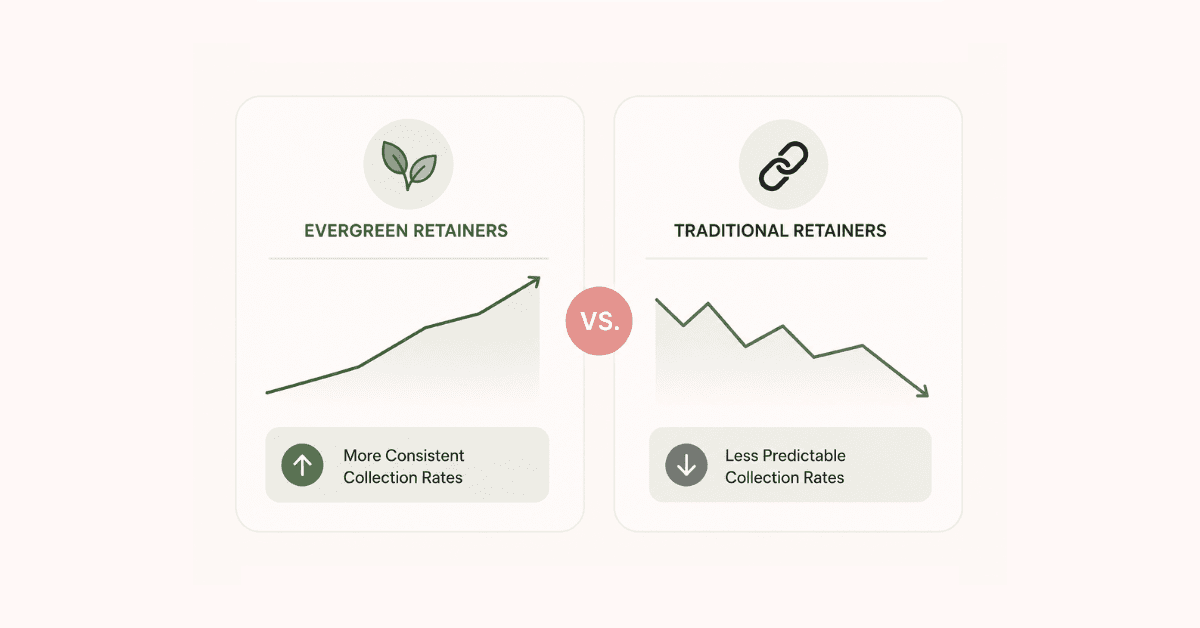
For the retainer-structure side of the equation, see Evergreen Retainers vs. Traditional Retainers. For the benchmark data, see Average Days in AR for Family Law Firms: The 2026 Benchmark Report. For the tooling layer, see Best AI Software for Family Law Firms.
External authority sources cited:

" height="16.57165px" id="usoExa717" transform="translate(1 2)" width="18.33337px"/></svg>)
" height="19.996073000000003px" id="slKA4m0c7" transform="translate(0 0)" width="19.9883px"/><path d="M 5.137 0 C 2.301 0 0 2.301 0 5.137 C 0 7.973 2.301 10.273 5.137 10.273 C 7.973 10.273 10.273 7.973 10.273 5.137 C 10.273 2.301 7.973 0 5.137 0 Z M 5.137 8.469 C 3.297 8.469 1.805 6.977 1.805 5.137 C 1.805 3.297 3.297 1.805 5.137 1.805 C 6.977 1.805 8.469 3.297 8.469 5.137 C 8.469 6.977 6.977 8.469 5.137 8.469 Z" fill="rgb(232, 124, 124)" height="10.273390000000001px" id="QoooNkCCR" transform="translate(4.863 4.863)" width="10.27342px"/><path d="M 2.399 1.199 C 2.399 1.863 1.859 2.398 1.199 2.398 C 0.535 2.398 0 1.859 0 1.199 C 0 0.535 0.539 0 1.199 0 C 1.859 0 2.399 0.539 2.399 1.199 Z" fill="rgb(232, 124, 124)" height="2.3984400000000003px" id="QF02FX4CF" transform="translate(14.141 3.461)" width="2.398500000000002px"/></g></svg>)
" height="19.999972999999997px" id="cGbUHvSUM" transform="translate(0 0)" width="20px"/></g></svg>)